Showing posts with label Freeport. Show all posts

Friday, September 27, 2024

Strangers with Some Gems

On October 9, 2023, a post appeared on the Facebook page of the Freeport Historical Society of Freeport, New York, an area settled by my 10th great-great grandfather, Edward Raynor, in the 1640s. The post shows a map from 1896, which is part of the Historical Society's museum collection. It includes a highlighted area that appears to delineate the boundaries of the town. Just above the northern perimeter is the name of my great-great grandfather, John M. Losee Jr. (March 25,1870 - May 24, 1940), written as "J. Losea" on the map. I commented that I was descended from him. 

Months later on July 24, 2024, a man, who I have never connected with before, replied with an image of my third great grandparents' marriage certificate; John's parents, John M. Losee (Sr.) (August 17, 1841 - February 10, 1918) and Susan Amelia Combs-Losee (October,1843 - January 8, 1904).

I had never seen the document before, I had no date for their marriage until that point, and we are unsure how his great grandmother came into possession of the document. But it is lovely.


You never know where, or who, might possess a piece of your family's history. I am delighted that it has been so well cared for and cherished for such a long time by its stewards, however they may or may not be related to me. Thank you, Russell!

Friday, February 24, 2023

Hey Universe, Stop Talking to Me so Early in the Morning

Weird things happen in research. Sometimes I notch it up to the Universe trying to speak to me; which is actually a phrase I detest. If the Universe is speaking to me, it's much too unclear for this early in the morning. It's 8 a.m. on a Friday morning before I have even finished my coffee.

In any case, sometimes when you do research, weird things happen. This morning I was looking to see if there were any news articles out there about the first female sports team at the College where I work. I tried poking around the Brooklyn Daily Eagle. Even though my college is clearly on Long Island, situated right on the boarder of Nassau and Suffolk County, the Brooklyn Daily Eagle picked up news from all over the Island, City, state, nation, and world. If you had anyone living in the City of New York you should check the Brooklyn Daily for a mention of them. It's free: https://bklyn.newspapers.com/paper/the-brooklyn-daily-eagle/1890/

So I did a "hail Mary" kind of search. I just put in some keywords; Farmingdale, agriculture, and basketball; and limited to the year 1925.

The first page that came up was page 24 of the November 27, 1925 edition. On that page there was nothing about our College's women's basketball team but there was the picture below of Miss Kathrine Boller.

The word basketball appears in the article about Kathrine and the other words appear scattered on the page in other articles but the weird thing is that, I know Kathrine Boller (September 17, 1908 - March 15, 1995). Well, I never met her in-person but I researched the hell out of her and her family. She is the daughter of Claude Villette Boller (March 1869 - August 2, 1951) of Freeport, New York. Katherine's second husband was Norman Holland Foote (December 12, 1909 - March 2, 1999). 

Now why did I research her?

Good question. Glad you asked.

Because here at Farmingdale State College we own the scrapbook of Katherine's father. I research that scrapbook for over a year and developed an online exhibit about its creator and its contents: https://bollerscrapbook.omeka.net/exhibits

Our only known connection to Mr. Boller would be through his son-in-law, Mr. Foote. Mr. Foote was a professor and the Head of the Agricultural Engineering Department at what is now Farmingdale State College from 1948 until his retirement in 1967. His career at Farmingdale began in 1933 when our institution was known as the State Institute Of Applied Agriculture. We assume that the College Archives must have acquired Mr. Boller's Scrapbook from Mr. Foote before he retired in 1967.  

It is a fascinating resource about the life of a noteworthy tailor from about 1883 - 1907. Mr. Boller established the men's wear department of the noteworthy Montgomery Ward & Co. in Chicago, Illinois. He began working for the famous catalog mail order company, Montgomery Ward, on September 29, 1896 and left on January 1, 1906 amidst the turbulent Chicago Teamsters' Strike. The Chicago Teamsters' Strike of 1905, which is noted as one of the bloodiest labor strikes in U.S. history, actually began in the Montgomery Ward & Co. cutting room where Mr. Boller was the manager

In any case, serendipity happens. Just thought I'd share. I guess the Universe is telling me to get back to work.


Monday, November 7, 2022

52 Ancestors Challenge Week 45: "Ghost Story" - An Apparition in Freeport

I don't really have family ghost stories, at least not one related to my family history. I mean both my sister and I recall separate instances of a ghostly apparition in the upstairs of our childhood home. The figure of a man dressed as a fly fisherman didn't seem to be a relative but ya never know.

My Uncle Walter, my uncle by marriage, now deceased, spoke of a home in his family located in Brooklyn that was haunted. Uncle Walter passed away in 2014 after a battle with brain cancer. Given that he is no longer with us I could not pin down a story. I clearly recall him referring to the "upstairs" of a brownstone being the residence of the specters and that he had either seen or hear a story of someone watching a toy roll back and forth across an upstairs floor. My sister recalls him speaking of sounds of a baby crying. Again, though, not really a ghost story I recall.

I once came across a story in a newspaper about a ghost in the town of Freeport, Long Island, New York where my Losee family lived. Several of the articles, and yes, there were several, mentioned an encounter between the specter and a John Losee. I am not entirely sure that the John Losee in the article was indeed my relative though. The articles describe him as a young man with the middle initial R. My great-great grandfather, John M. Losee Jr., would have been about 23 at the time and although that sounds young to me now, hmm, the article gave me the sense that this was a teenager interviewed.

The story I first saw appeared in the Brooklyn Daily Eagle on November 19, 1893, page 20. (See below for article, followed by a transcription for those who cannot read the image).

An Apparition in Freeport

It Appears to be a Man Seven Feet High and Waltzes on One Foot

Freeport, L.I., Nov. 18 - Fearful hearts are beating in this village to-night. Fathers have deserted warm firesides and mothers have sent their sons forth to rid Freeport on an apparition. Men are patrolling the streets armed with weapons of war of modern and ancient make, ready to shoot the strange being if it appears in their path.

The apparition made its initial appearance in Freeport's streets a week ago. It has held undisputed away after nightfall ever since. The vicinity of lower Main Street has been the favorite haunt of the mysterious being. That portion of the street is lined on both sides by large trees and is shrouded in deep gloom after nightfall. Aside from the attractions mentioned it is a favorite spot with the youth of the place.

Miss Pauline Klein was being escorted home by Joseph Bennett of Hempstead. When near a place known as the Dell Raynor property a man jumped from behind a tree. He began a high-kicking act on the sidewalk. Miss Klein uttered a piercing shriek and clutched Mr. Bennett's arm.

"Oh! Joe! Joe! what is it!" asked the young woman, in husky tones. Before Mr. Bennett could reply, the strange being made a dash for the couple. Miss Klein and her escort fled down the street. Finally when forced to stop for want of breath, they turned and looked back. There was no one in sight.

The apparition has been seen several times since that night and has frightened a number of persons. Martin Acorn, employed as a hostler in a village hotel, had a lively experience with the apparition last night. A little later John Losee walked down Main Street whistling the "Girl I Left Behind Me," when the apparition jumped from behind a house and began to waltz towards him on one foot.

Those who have seen the "terror" describe him as a man 7 feet in height, with red flowing side whiskers and a face as white as snow. His face looks as if it was painted. His clothing is ragged, and, in running, he has a knee action like a trotting horse.

It makes me laugh what was taken for news, then and now to be honest. The story was also covered in the New York Times, The World, The Buffalo Currier, The Buffalo Weekly Express, and The Sun. Yes, prominent publications. The Sun was the paper in which, just 4 years later on September 21, 1897, Francis Church responded to 8 year-old Virginia O'Hanlon with the now famous line "Yes, Virginia, there is a Santa Claus." And as Virginia's papa said, "If you see it in The Sun it's so."

The Buffalo Weekly Express had more lurid details of John's encounter with the apparition running around Freeport in it's November 30th coverage.

John R. Losee got closer than either of the preceding witnesses. The shape appeared to Losee while he was going home about 10 o'clock on Thursday evening (probably November 23, 1893). Losee agrees on the eight feet tall and white hair on the face, and adds that the features looked like a man and wore very ragged clothes. Losee was walking in lower Main Street when the creature attacked him. Losee reached out his hand to catch the monster, but it dissolved as it had done in the presence of Austin Ellison, Losee says you can't hear the ghost's feet strike when it runs.

Now the apparition is 8 feet tall. Grew a foot since the last newspaper. The November 26th edition of The World revealed that the culprit had already been unmasked though; like a scene from Scooby Doo. It was no other than a few high spirited local young men. 

As was stated in The World at the time, the so-called ghost first appeared here [Freeport, Long Island, NY] on Nov. 12 [1893]. From that time until last Thursday [Nov. 28] the entire town has spent more or less time hunting the apparition or fleeing from it. On that night one of the "ghosts" was caught.

The air of this place seems to have been filled with all the ingredients that make what are known as practical jokers. It appears not that this air affected some of our young men. Charles H. Lott, Jr., was the first affected. Dressed in a gunning suit of heavy brown canvas and a "sou'wester" hat he was on his way to the bay late Sunday night, Nov. 12, when he suddenly came across Joseph Bennett and Miss Pauline Kleinert sitting on the front stoop of the young woman's home. Thinking to elude  them Lott was sneaking around the house when Bennett caught sight of him and started towards him. Lott then started  on a run across the lots and soon outdistanced Bennett, who returned to the young woman. They discussed the matter and came to the conclusion that they had seen a ghost. The following Wednesday [November 15] night a "ghost" in the person of Harry Smith, twenty-two years old, appeared on the main road and was chased by quite a crowd. The "ghost" was lost in the woods. Smith had conveniently climbed a tree.

On Sunday [Nov. 26] last, Allison [I think this is really Austin as mentioned in the article above] Ellison who had been Smith's confederate, dressed himself in feminine attire and startled half the town by running like mad through the main streets. Through the efforts of Smith a crowd gave chase and followed "Ghost" Ellison to a pond, where the crowd lost sight of him. He had unhesitatingly plunged into the water and swam away.

The next evening [Monday, Nov. 27] William Bouschier, one of the reputable young men of the town decided to catch the ghost. He did so. Louis Friedman, employed by Henry Mead's bakery, had arrayed himself in all the clothing necessary for a well-equipped ghost and late at night started out. He had not gone far when Bouschier got on his track and caught him in the woods where Friedman, fearful of a beating made known his identity.

So let's see that "ghost" was at least 4 people -  Charles H. Lott, Jr., Harry Smith, Austin Ellison, and Louis Friedman. Not exactly a witch hunt but a little mass hysteria for the village.


Monday, July 25, 2022

52 Ancestors Challenge Week 30: "Teams" - Writing with Cousin Mary

Recently, my Cousin Mary and I have committed to work together to contribute a column about genealogy research to a family newsletter, called The Raynor Shine, put out by the Raynor Family Association. Mary and I are 6th cousins once removed. Our common ancestors are descendants of Edward Raynor (1624 - 1685).

Edward Raynor set sail for the New World from Ipswich, England in April of 1634 aboard a ship called the Elizabeth. He was just 10 years old at the time. Orphaned, he came to the New World with his uncle, Thurston Raynor and his wife, Elizabeth, and their 5 children; Thurston, Joseph, Elizabeth, Sarah, and Lidia. There was another minor traveling with this family, Elizabeth Kemball of whom I know nothing. There were other Kemball families aboard the same ship but Elizabeth (age 13) is listed as a ward of Thurston Raynor the elder.

The Raynors first settled in Watertown, Massachusetts, then Wethersfield and Stamford, Connecticut before heading to Hempstead, Long Island, New York in 1644. Edward is noted as one of the original settlers of Hempstead. He was a large landowner, credited with settling the area now known as the Village of Freeport in Nassau County in 1659. At one time the area was known as Raynortown. He died in about December 1685 or January 1686

Cousin Mary and my most recent common ancestors are Jacob Raynor (unknown - March 1829) and his wife Rebecca Raynor-Raynor (June 10, 1769 - February 14, 1855). That's right Raynor-Raynor. Enter endogamy; the custom or constraint of marrying within the limits of a local community, clan, or tribe. Rebecca was a Raynor who married a Raynor. Aside from spouses, I am unsure of the relationship between Jacob and Rebecca but they were likely cousins of some ilk. The Raynors were a big Long Island family. We aren't exactly sure who Jacob's parents were but Rebecca was the great-great granddaughter of the aforementioned Edward Raynor.

Mary and I have teamed up on many occasions to research potential parents for Jacob. It's so hard to sort out when the region was so densely populated with Raynors. And Jacob is not exactly a unique first name. There were dozens of Jacob Raynors in the area of relatively the same age. And to date, no other Raynor family researcher has been able to show me a source stating my Jacob's parentage. Oh sure there are trees out there naming his parents but are they documented? NO. And to some extent I'd be okay with that if the tree maker told me their source. Did grandma tell you that? Did you read it in some book? Just tell me where ya got that from but NOoooo.

So I am hoping Mary and I can use our column to help our Raynor cousins to do some quality research and share their sources. I am looking forward to the experience of co-authoring with one of my favorite genealogical finds; Cousin Mary.

Tuesday, July 19, 2022

52 Ancestors Challenge Week 29: "Fun Facts" - A list of 10

Here are some fun facts I have in my family history:

1. My parents grew up next door to each other. 
That's not an expression. They literally lived next door to each other.

2. I come from a long line of seafaring men yet just looking at the ocean can make me seasick. 
Both my grandpas served in the navy in WWI. My great grandpa, Abram Earle (January 13, 1891 - November 18, 1973) started building his own boat. His father, my great-great grandfather, Abraham Earle (About 1849 - Fall 1890), died at sea abroad a ship called The Rise and Go in Newfoundland. Abraham's father-in-law, my 3rd great grandfather, Reuben Samms (About 1830 - October 7, 1869), also died at sea during a seal hunt. Another of my 3rd great grandfathers, John M. Losee (August 17, 1841 - February 10, 1918), had a brother, Leander L. Losee (November 8, 1846 - April 23, 1917), who served in the Navy during the American Civil War and was captain of a life saving station along the south shore of Long Island. And yet another 3rd great grandpa, John Aloysius Joyce (February 11, 1829 - September 30, 1910), served in the U.S. Navy during the Mexican-American War (mid-1840s) at 16 years-old as a cabin boy on the U.S.S. Potomac. Boat people! I'm queasy just writing this.

3.  My family has multiple children born on their parent's birthday. 
My grandmother was married on her 20th birthday and then had her 3rd child on the same date 5 years later, February 27. That son's ex-wife had their second child on her birthday, June 2. My grandma's brother, Robert, had his first child on his birthday, October 21.

4. My mother, my paternal aunt, and my step-mother were all in the same graduating class at the same high school.

5. My father's sister married his best friend from high school. 

6. Both my brother-in-laws were best friends in high school too. 
And get this, those boys when to the same high school as mom, Aunt Jane, and my step-mom.

7. I have a pair of aunts who married brothers.
Also, my great-great grandmother, Flora Smith-Losee (Mar 1875 - September 1, 1920), and her a sister, Melinda Smith-Losee (November 1, 1869 - August 19, 1955) married brothers; John M. Losee Jr. (March 25, 1870 - May 24, 1940) and Oliver Combs Losee (May 3, 1868 - February 10, 1937), respectively.

8. I have two 5th great grandfathers who served in the American Revolution; Colonel Daniel Moore (February 11, 1730 - April 13, 1811) and Lieutenant Colonel Robert Moore (May 22, 1724 - October 27, 1778).
And... they were brothers whose children married. Yeah my 4th great grandfather, William Moore (1763 - July 1817), and 4th great grandmother, Eleanor Moore (1767 - October 19, 1836), were 1st cousins.

9. William and Eleanor Moore helped settled the area of St. Felix-de-Kingsey, Quebec, Canada in 1803.
"Settler" is just a term for people showing up and building a house, typically to colonize the area and thus, typically European white people were settlers.

10. I descend from the man who settled Freeport, Long Island in 1659; Edward Raynor (1624 - 1685). 


Tuesday, May 3, 2022

52 Ancestors Challenge Week 18: "Social" - Family in the Freeport Fire Department

I am not much of a joiner, that is to say that I don't belong to a lot of clubs or organizations. The few organizations I do belong to I do so just in name really. For the most part, I pay my dues for the benefit of receiving whatever publications the organization provides its members or to have access to some database or discounted service. In short, I'm not one looking to lead. I do enjoy attending a conference or two though. Such events provide opportunities to be social.

I don't find many records for my ancestors being active in clubs or organization either except my paternal grandmother's parents, Charles Henry (March 26, 1896 - June 14, 1949) and Anna Marie Sauer-Henry (July 19, 1899 - May 8, 1986) who were leaders in their Rabbit Club and Goat Club. I wrote about the goats a few times in my blog. 

But then there is my paternal grandfather's dad, Abram "Abe" Earle (January 13, 1891 - November 18, 1973), who, along with his brother-in-laws, was active the the Freeport (NY) Fire Department.

Amongst the family treasures that have been bestowed to me overtime, there are photos that once belonged to Abe and his wife, my great grandma, Ethel Mae Losee-Earle (February 14, 1896 - May 27, 1960), that show some organizational gatherings. Some of the photos show Ethel's brothers and Abe in their fire department dress uniforms gathered around the company's trucks.

This image was included in an Images of America book about Freeport, New York. It was written by Cynthia J. Krieg, who is affiliated with Freeport Historical Society, and Regina G. Feeney, a librarian at Freeport Memorial Library.  My grandfather's maternal uncle, Luman Losee (June 26, 1894 - January 13, 1954) is in the front row #4 from the right. I think her brothers, Fredrick Losee (About 1903 - May 5, 1926) and Forest Losee (August 11, 1897 - February 2, 1945) are also in this image but I can't pick them out. My grandpa knew his Uncle Forest but my father didn't; Forest died very young. Uncle Fred died even younger. He died in an accident, he fell off a roof. Again, though I suspect all 3 brothers, Luman, Fred, and Forest Losee are in this picture below.

For those of you unfamiliar with the series, Images of America, published by Arcadia Publishing, they are kind of like photo albums of a specific community. Each image is captioned though, however, there isn't a lot of text to these books. These aren't heavy history books. They're really kind of fun. They're a great way to introduce novices and young people to the history of their community. There might be one about your community, if not, think about creating one. I understand Arcadia is very easy to work with. 

There is also another book in which the above photo appears; An Illustrated History of the Freeport Fire Department, 1893-2008 by Miguel Bermudez and Donald Giordano published in 2008. I am not acknowledged in the book, nor is credit given to my family's photo collection but I did give digital images to one of the authors of all the Freeport Fire Department photos in my family's possession and they appear on pages 111 - 113. Including this one below of what my grandmother calls a ragamuffin parade. The image horrifies me as it shows several member in black face; a truly racist imagery. 


In the Illustrated History, this image is captioned identifying Luman as the drum major and Forest as the tuba player as well as my great grandpa, Abe, as the clarinet player, kneeling # 3 from the right. Now I can pick Abe out based on other photos I have seen of him. I know his son, Allen, played clarinet, as did I in school. However, I didn't know Abe played clarinet as well. I believe the clarinet that belonged to his some, Allen Earle (March 17, 1916 - November 8, 1956), is still in the possession of my Uncle Thomas, now if that clarinet was also Abe's clarinet, pictured above, I have no idea. Anyway - - horrifying image, right?

These parades were an annual occurrence in many communities in the New York metropolitan area. Typically they were held around Halloween and featured children in their costumes, but obviously, this wasn't just a children's activity and I do not know when it took place because the photo is not labeled but it has to be after April 30, 1923 when the Russell Park section of Roosevelt, Long Island, New York was annexed into the town of Freeport. I can tell from the band's drum.

There were ragamuffin parades and then there was also Ragamuffin Day, which was something else entirely that my grandmother has told me about. Begun around 1870, Ragamuffin Day was once part of Thanksgiving celebrations which my grandmother recounted participating in to me on several occasions. Much like Halloween, it involved children going door-to-door dressed as beggars seeking candy and playing tricks on non-complaint homeowners; soaping windows, ringing doorbells and running away, and similar shenanigans. Grandma said that she and her siblings didn't just beg for candy but preformed little skits, sang songs, or did some dance for the neighbors who provided them with sugary treats or change.

The racist image of the ragamuffin parade in Freeport disturbs me, but it also reminds me a little bit of a much less scornful social practice that still takes place in Newfoundland, where my great grandpa Abe was born. There they have Mummers.


Creepy as all get out Mummers go mummering or mumming. It is a Christmas-time, house-visiting tradition in which groups of friends or family member dress in disguise and visit neighbors. If welcomed in, the mummers often do an informal performance followed by the homeowner having to correctly guess the mummers' identities. Once identified, the mummers remove their disguises and spend some time eating and drinking with the hosts before traveling on as an even bigger group to the next house.

One thing about that Russell Park section of Roosevelt/Freeport, that is where my family lived long before Lillian Russell for whom the section was named. Lillian Russell, an incredibly well-known actress of her time, lived in the area. She was born Helen Louise Leonard and the Illustrated History states Leonard Avenue in Freeport was named after her. I beg to differ. I am certain Leonard Ave is named after the man who originally owned the property, that would be my 4th great grandfather, Leonard Losee (January 21, 1817 - November 21, 1886). Let me show you.

Here is a map from 1914. The green box represents the original size of the property owned by my Losee family. The red box indicates the last bit of Losee Family property sold to local developer and politician, Albin Johnson, in 1912. The street highlighted in yellow shows Luman Street. Luman? Sound familiar? It no longer bears his name but prior to WWI and the family's sale of their property, the map shows the first 1500 feet of the western end of Independence Ave was called Luman Street after my grandpa's uncle. The blue boxes show two homes owned by Losee family members on Stevens Street, once known as Losee Place. The northern blue box was owned by F. Losee, could have been Forest Losee but might have been Frederick, and the lower blue box was owned by Georgianna Losee (July 19, 1866 - November 29, 1935), the sister of my great-great grandfather, John M. Losee Jr. (August 17, 1841 - February 10, 1918)

Street naming business aside, all these aforementioned social practices give me a sense that my great grandparents generation, often referred to as the Lost Generation (those born from 1883 to 1900 who came of age during World War I and the Roaring Twenties), were involved in their communities and socialized with their neighbors in a way that I have not experienced in my lifetime. Sure I belonged to Girl Scouts as a kid and sold cookies door-to-door. I marched with the Junior High and High School bands on Memorial Day playing my own clarinet too, but I don't think I experience "community" quite like they did. And, honestly, I'm a bit jealous that I don't have that sort of natural inclination to be part of my community. 

Monday, April 11, 2022

52 Ancestors Challenge Week 15: "How Do You Spell That?" - My Third Great Uncle, Private Benjamin F. Losee

All genealogy researchers have encountered errors in spelling. I don't like to call them errors really. I prefer to call them alternative spellings, but let's face it, April, sometimes it's just wrong. Anyway, it can be very hard sometimes to convince novice researchers that spelling is not a big deal. Just because a name is spelled differently than what you are expecting to see does not mean that record ... or headstone ... does not belong to your specific person. That's right, a headstone.

Early on in my foray into genealogy I encountered Benjamin Franklin Losee's name recorded on a Civil War Memorial plaque at Freeport Memorial Library in Freeport, New York which is on Long Island. For many years I worked to learn my connection to Ben and details about his life and death in the American Civil War. I knew I had to be related to him. My Losee family lived in Freeport for many generations, as did my Smiths but Losee is not Smith. It is not nearly as common a surname.

Ultimately, I came to learn that Ben was my 3rd great grandfather's brother. During his lifetime he lived on the Losee Family property which is now Stevens St. in Freeport, right near the border of Roosevelt on the east side of Main St. 

I only have an approximate date of birth for Ben. However, I know for sure he was a private in the 139th New York Infantry, Co. A. From his military pension file I know he died of disease in Point of Rocks, Virginia but even the U.S. War Department did not have an accurate date of death for him. I also struggled for years to find where he had been buried.

His remains were interred in City Point National Cemetery, Hopewell, VA. According to some papers, he died in the Fall of 1864. Other documents state he died October 1, 1864. However, his new headstone says December 5, 1865. Oh yes, a new headstone.

Part of the reason it took me forever to determine Ben's burial location was because he was buried under a headstone with the surname "LOSA" even though his military files, which contain handwritten letters signed by Ben himself, clearly say LOSEE. 

It also took me forever to get the headstone replaced.  It was quite an ordeal. A letter to my congresswoman got it corrected though. However, I had to supply the government with proof of the correct spelling by submitting to them copies of Ben's signed letters straight form the government's own files. Oy! But here it is though - - the original stone as it appeared in about 2000 and the new one that I believe was erected in 2004.


Monday, April 4, 2022

52 Ancestors Challenge Week 14: "Check It Out" - My Annotated Bibliography of Publish Local and Family Histories

As a librarian, this week's theme of "Check It Out", of course, makes me think of library books. There are several wonderful published family histories that I have discovered about various lines of my family tree. And, like a librarian, here is my annotated bibliography for you. These come straight from my personal library. You'll have to forgive me my formatting. Blogger doesn't allow me to create hanging indents:

Berger, Antony R. The Good and Beautiful Bay: A History of Bonne Bay to Confederation and a Little Beyond. St. John's, NL: Flanker Press Limited, 2014.

This book is about the history of the Bonne Bay region of western Newfoundland, in the heart of Gros Morne National Park. It encompasses the communities of Woody Point and Norris Point where my great-great grandmother, Sarah Samms-Earle-Bromley (October 13, 1857 - March 20, 1899), was born and where she lived until she married my great-great grandfather, Abraham Earle (1849 - 1890) of Twillingate, Newfoundland. Sarah and her parents are mentioned in the text by name but my favorite detail is on page 95-96. "Across the tickle [that is what Newfoundlanders say for a narrow salt water channel] from Norris Point is Gadds Harbour...When families moved, their houses commonly went, with them, as did the Sammses' in Gadds Harbour..." To the right of that statement is the photo below of my family's home bobbing across the water and a caption above which read "The Samms house, the last in Gadds Harbour, was floated across The Tickle to Norris Point (Woody Point Collection)." Remarkable, right?

Evans, Calvin. Master Shipbuilders Of Newfoundland And Labrador, Volume 1: Cape Spear to Boyd's Cove. St. John's, NL: Breakwater Books Ltd., 2013.

If you have family from the province of Newfoundland and Labrador, you likely have a shipbuilder somewhere in your family tree. This author explores every coast, bay, and harbor around the "Rock" chronicling each craftsman's productivity. I only own Volume 1. Chapter 5 covers The Straight Shore and "Fogo, Twillingate, and Morton's Harbour" where my Earles came from. Page 204 mentions John Earle of Farmer's Arm. I am not sure how I am related to John but that is where my great grandfather was born. I am certain I am related. I think the John they speak of could be my great grandfather Abram Thomas Earle's first cousin, John Earle (August 11, 1863 - May 8, 1913). It names 4 ships he built between 1900 and 1908: The first, name not recorded but was built for John B. Lock of Twillingate, then there was the Invincible, Snowbird, and the John Earle.

Flynn, Michael F. Historic Bay Roberts: Not Your Typical Small Town. St. John's, NL: Flanker Press, 2011.

The first paragraph on page 2 of this books begins, "John Earle, Sr. was born on November 1, 1678, in Poole, Dorset, England but moved to Newfoundland..." Now I'm not sure that is my ancestor but my great-great-great grandfather Elias Earle was born in about 1808 somewhere in Newfoundland and died in Twillingate, Newfoundland on February 28, 1875. Twillingate is less than 250 miles from Bay Roberts, Newfoundland. So do I think there is a connection between my Elias and that John - - yeah, probably, which is why this book is in my collection.

History of Bedford New Hampshire from 1737: Being statistics compiled on the occasion of the one hundred and fiftieth anniversary of the incorporation of the town, May 15, 1900. Concord, NH: The Rumford Printing Company, 1903.

The first time I encountered this book was online through Google Books but I have since purchased a reprint of it. Since then it has also been digitized and made available through Ancestry.com. My Moore family ancestors were early settlers of Bedford, NH as well as Londonderry (now Derry), NH. Lineages and stories about the family are scattered through out this 1100+ page book. My favorite part, though is the list of illustrations that directs the reader to page 480 and an image of Col. Daniel Moore's house and Moore's Tavern. A tavern you say. That explains some things. The images do not reproduce well so in short, these structure existed during the American Revolution. Daniel Moore, sometimes with the silent "e" and sometimes without, was my 5th great grandfather and a colonel in the American Revolution, present at the surrender of General Burgoyne.

Lore, Gordon and Hector Earle. The Earles of Newfoundland and Labrador.  St. John's, NL: DRC Publishing, 2015.

The title kind of says it all. This book does not make much mention of my particular line of Earles. Earle is an old, rather common surname in Newfoundland. On page 174, though, the author lists my great-great grandfather, Abraham Earle ( About 1849 - 1890) who died aboard a ship called the Rise and Go. On page 180 my great grandfather, Abram Thomas Earle (January 13, 1891 - November 18, 1973) is listed, stating he was the son of Abraham and Sarah Samms-Earle of Twillingate. The details of both entries are not entirely accurate but does not diminish the richness of details included within the resource.

Moore, George Washington. Genealogy of the Moore family of Londonderry, New Hampshire and Peterborough, New Hampshire, 1648-1924.  Peterborough, N.H. : Transcript Print. Co., 1925.

Again, I first encountered this book was online through Google Books but I have since purchased a reprint of it. It has also been digitized and made available through Ancestry.com and FamilySearch.org. And this really, really follows my particular line of the Moores for multiple generations. It is more of a giant pedigree chart than a story though. I kind of like the books that have more story to them.

The book starts with John Moore (1648 - February 12, 1692) who was a member of the McDonald Clan of Glencoe, Scotland and who was killed there in a massacre by the Clan Campbell, a rather famous conflict. I am not 100% sure if I am descended from this man or his brother, Samuel. The dates of birth and death seem to vary from resource to resource. I know these are my people though. My research through documentation leads clearly from me to Col. Daniel Moore (February 11, 1730 - April 13, 1811), colonel in the American Revolution, from Londonderry, now Derry, NH

Moore, J. Clifford. The Life and Times of a High School Principal in Rural Quebec. Canada: The Townships Sun, 1996.

This book reflects on my mother's Canadian line, the Moore family, which I have written about quite a bit in my blog. It particularly highlights my 4th great grandparents, William Moore (about 1763 - July 1817) and Eleanor Moore-Moore (about 1767 - October 19, 1836) who were the second pair of settlers to arrive in what is now St. Felix de Kingsey, Quebec, Canada in about 1801 from their birthplace of New Hampshire. On page 56 there is an image of about 25 school children taken in 1912, one of which I believe is my great grandmother's brother, Daniel Sharp, labeled as Dan Sharpe. On pages 105-107, there is a listing of those buried in the Moore Family Cemetery. On that very last page is the entry for my great-great grandfather, Daniel Sharp (March 14, 1822 - October 12, 1898), and his mother, Anne Moore-Sharp (about 1782 - January 14, 1868). I have been to this family cemetery. Although it has fallen into disrepair, it is located right along the St. Francis River, an incredibly beautiful spot to spend eternity if you ask me.

Peyton, Amy Louise. River Lords: Father and Son. St. John's, NL: Flanker Press, 2005.

This book was gifted to me by the homeowner of the AirBnB I stayed in on Farmers Arm, Twillingate in 2018; Kinda-Cousin Charlie. Charlie now owns the land that once belonged to William and John Earle, my great grandfather's uncles. I am not descended from the Peytons of Twillingate, Newfoundland but my great grandfather, Abram Earle's brother-in-law was Edgar Paint Peyton (February 14, 1877 - October 20, 1964). Edgar was the man who surveyed Charlie's land when it belonged to my Earles.

Edgar was number 7 of 10 children of Thomas Peyton (December 28, 1827 - September 5, 1912). Thomas's personal journals are featured prominently in the book and include reflections on stories told to him by his father, John Peyton the younger. (Baptized January 21, 1793 - July 25, 1879), about his grandfather, John Peyton the elder (1747 - About 1827 or 1829), including descriptions of the variety of economic activities pursued by John Sr. in the predominantly dried-cod economy of  Notre Dame Bay. It is a blend of regional and family history based primarily on private Peyton family papers in the author possession which had not been previously available to academics. 

Although the author does try to dispel the shameful narratives previously written about the atrocities committed by the Peytons, especially John Sr., against the native peoples, the Beothuks, Amy Louise Peyton's direct connection to the main characters paints a unique image of Atlantic pioneers.

Potter, Ralph Kimball. Early Southards of New York and New Jersey. [Place of publication not identified]: [publisher not identified], 1974.

Not every book I have is about my Canadian ancestors but apparently most are, this one is not. Three years ago the College I work for was celebrating the centennial of its first graduating class. The valedictorian of the class of 1919 was Bradford Southard of Freeport, New York. When I tracked down his daughter to invite her to campus I mentioned to her that we were probably related. My family settled Freeport and Southard is an old Long Island family name. After discussing her family history, I came across this book in the library collection of Wantagh Public Library. It helped me to piece together not only Bradford's family line but my own as well. Thomas Southard (1615-1688) is my 9th great grandfather. 

Publish histories can be just as flawed as anyone's Ancestry family tree. Authors should provide the sources from which they have taken their names, dates, and details but often they do not. A published family history though, can be rich with information about the area and culture from which your family came. In short, such sources should not be ignored; scrutinized but not ignored.

Tuesday, March 22, 2022

52 Ancestors Challenge Week 12: "Joined Together" - Meeting Cousins

I suppose this week's theme of "Joined Together" is supposed to cause me to reflect on marriages in my family history but the cynic in me only makes me think of the many divorces I see in my family history. In effort to be uplifting in my posts, I'd rather write about something that makes me happy; meeting cousins.

I have many known cousins to begin. I am one of 9 first cousins on my mother's side and one of 10 first cousins on my dad's side; subtracting siblings from the mix, I have 12 first cousins in all. However, I have acquired so many distant cousins since doing online genealogy research and especially since doing an AncestryDNA test back in November of 2013. Some of them I communicate with for only a brief time, exchanging information to enhance our respective family trees. Others I have communicated with sporadically for years and years.

There are so many that I can't possibly list them all. I'll highlight a couple of them though. These are ones I have acquired strictly through genealogy research...

The One Who Has Been Around the Longest: Cousin Mary

Cousin Mary is my father's 6th cousins and thus my 6th cousin once removed. We have my 6th great grandparents in common; the elusive Jacob Raynor (unknown - March 1829) & Rebecca Raynor-Raynor (June 10, 1769 - February 14, 1855). That's right. You read that correctly, Rebecca Raynor-Raynor.

We have deep Long Island roots that reach back to the settlement of Freeport, New York which at one time was known as Raynortown. One might think Raynor is not a common surname but at that time, in that place, there were SO many Raynors. I am sure Jacob and Rebecca were cousins of some ilk but both Mary and I struggle to confirm Jacob's parents.

I honestly can't remember how long ago Cousin Mary and I met, maybe since 2005-ish, but we have "joined together" on many occasions. We have done a few research trips, attended a conference, and did a genealogy presentation together. We met back when Ancestry showed you other users who had connected to the same records.

I recall being quite dismayed when we did not match on AncestryDNA though. I thought for sure I had made some research error and that Mary was not my cousin after all. Oh, I was so sad but I was quite relieved when it turned out that, although my father and I do not match Mary, my 2 uncles do. It proved that it is possible to have no genetic match with distant cousins.

It is about 2 years ago now that another researching cousin on our line passed away. Recently, Cousin Mary and I accepted the generous honor of inheriting that cousin's boxes of resources. We also recently planned to attend another conference together in June. Can't wait!

Thus, Cousin Mary and I have "joined together" in many research endeavors. She is one of  my best genealogical finds.

The Non-Genealogist Genealogy Acquired Cousin: Cousin Chris

Cousin Chris is not a genealogist. He and I are 3rd cousins on my mother side. This is the side of the family that I really don't have many strong bonds with so it is nice to have cousins on that side turn up. 

Cousin Chris and I have our great-great grandparents in common; Damas Desjardin, also known as Thomas Gardner (October 9, 1850 - October 2, 1911) and Malvina Ethier-Desjardins (February 2, 1864 - January 6, 1944). I met Chris by way of his brother, Cousin Robert, who is the genealogist. However, I have never met Cousin Robert. He posted a question to a message board a long time ago, around 2009, and then put me in touch with his siblings via FaceBook.

At the time Chris kindly extended an invitation stating, "If you're ever in Minnesota..." Well guess what, my constant road companion Cousin Pete and I were off to Minnesota in the summer of 2015. Cousin Chris (who is no relation to Cousin Pete, by the way) put us up in his home for 4 days, no questions asked. His beautiful wife and fabulous kids were so welcoming. The little cousins, gave up their beds for us. By the end of our stay Cousin Chris inquired, "Um, how are we related?" Needless to say Pete and I have been back to visit Cousin Chris and his family several times. In fact, this past summer we met up with them in Philly and stayed in the worst AirBnB I've ever stayed in in my life. Cousins made it tolerable.

The Not Quite Sure How We Are Related Cousin: Cousin Tim

A little over a year ago I received an Ancestry Message from Cousin Tim stating that he had been looking at his cousin's DNA matches and discovered I managed a few of the test with whom he matched, my father's and one of my uncles. They are distant DNA matches and originally we thought perhaps it was a connection to the Hinch family of Hacketstown, Ireland but then again, it could be through the Hughes family of Liscolman, Ireland. Either way both are in Wicklow Co. and on Grandma Earle's line. We're related somehow. I hope some day we can figure it out. Either way though, we're still cousins.

The Cousin Who Made Me Jealous by Getting to Visit Our Ancestral Homeland: Cousin Carol

Those of you who know me in real-life, you likely know that I am a ferocious road-tripper. I have been to all 50 states and all the provinces of Canada with the exception of Nunavut. Aside from Canada though, I haven't done much travel outside of the U.S. Cousin Carol has been to the most "exotic" of all my ancestral homelands though, the Czech Republic. My ethnicity pie chart reflects 99% European, most of which is from the British Isles and Ireland, thus Central European seems exotic to me.

Cousin Carol and I are 3rd cousins once removed, meaning she and my mother have my 3rd great grandparents in common; Jan Prinz (May 14, 1826 - May 22, 1888) and Franzisca Preuss-Prinz (November 17, 1830 - November 29, 1902) who were from Mladá Vožice, in Southern Bohemia, which is now the Czech Republic.

After years of researching our shared ancestral line, in the summer of 2013 she had the opportunity to visit the Czech Republic with her husband to celebrate their 40th wedding anniversary. They hired personal, professional tour guides who arranged ancestral tour and provided genealogical research which included meetings with village and church historians. Not only did they get to travel the roads our ancestors would have traveled, they got to visit the church where my great-great grandfather was baptized and had the privilege to ring the church bell which had been cast in 1491.

Even though we did not "join together" for that trip [JEALOUS], I did live vicariously through her and asked her to guest blog about her travels for me.

The Fancy Meeting You Here Cousin: Cousin Sylvain

In June of 2018, I had a second opportunity to visit Twillingate, Newfoundland, my Earle family's ancestral homeland. I had a truly astonishing genealogical discover then. I have written about the experience before but it still overwhelms me when I think about it. 

In brief, Twillingate is where my great grandfather, Abram Thomas Earle, was born in January 1891 on Farmers Arm which is on the Durrell side of Twillingate. On my second visit I went with my Uncle Tom. We stayed in a magnificent AirBnB called The Pumpkin House located right on Farmers Arm Road. One of the homeowners, Charlie, had recently purchased another house just a few doors down from Pumpkin House on the same road. 

One day he invited us down to his new house to show us his deed. It clearly shows a survey conducted by Thomas Peyton who was once the local magistrate and was the father of Edgar Peyton; the brother-in-law of my great grandfather and thus my uncle's great uncle. 

It turns out that Charlie's property was once owned by John Earle. Yup an Earle! The deed also indicated the land was once owned by the Late William Earle who, one would assume is the father of John, the aforementioned land owner. William Earle was my great grandfather's uncle. My gut tells me that my great grandfather was born on Charlie's land.

But it gets crazier. While Uncle Tom and Charlie poked around in one of the old structures on the property, I chatted with Charlie's friend, Sylvain. Our conversation went a little like this.

April: "So do you live here year round?"

Sylvain: "No, I live in Montreal."

April: "Oh, that's where my mom's side is from. My father's side is from here in Twillingate but my mom's side has deep roots in Montreal."

Sylvain: "I have ancestors who were early settlers in Montreal. What's the family name?"

April: "It would have been Desjardins." 

And Sylvain froze. This very blank expression came across his face and he slowly said, "My mother's maiden name is Desjardins."

Turns out Sylvain is Cousin Sylvain. He and I have my 9th great grandfather in common; Claude Jourdain Desjardins Charbonnier (1636 - about 1704-1711).

Crazy stuff; to not only find my father's family homeland but to meet a maternal cousin on that land - kind of crazy! By the way, my mother and father grew up next door to each other.

Since meeting, Cousin Sylvian has helped me with finding some information about our Montreal roots. Lovely man.

The Most Recently Acquired: Cousin Kristen

Just before Christmas 2021, I got in touch with a new DNA match, Cousin Kristen. She too is a cousin on my mother's side. Again, I have so few strong connection of that side that I am always excited by the potential for new relationships there.

Just recently we met in-person for the first time. We talked as though we were old friends catching up. I hope that such visits will become common place for us.

At this first visit, Cousin Kristen gave me a ring her and her mother chose for me a limited number of family heirlooms. She joked about proposing to me with it. I haven't taken it off.

Monday, February 7, 2022

52 Ancestors Challenge Week 6: "Maps" - 4th great grandmother, Lydia Ann Smith-Losee

I shared this map a few weeks ago. 

It is an 1873 map of the northern end of Freeport in a section that was once known as Greenwich Point. Now the area is Roosevelt. My 4rd great grandfather Leonard Losee and his son Leander Losee owned large tracts of land clearly indicated on the map; towards the bottom on the right side of the map.

Leonard's wife, Lydia Ann Smith-Losee, my 4th great grandmother, was born May 15, 1820 and died on December 31, 1887. She lived her life in what is now Freeport and Roosevelt, Long Island, New York. She married Leonard L. Losee (21 January 1817 - 21 November 1886) and together they raised 5 children: Mary Jane, John M., Benjamin Franklin, Leander L., and Sarah Elizabeth; all born between 1840 and 1856.

Many years ago it was brought to my attention that there was a Losee Family bible. I don't remember the cousin who had the bible in her possession. It was one of my Grandpa Earle's second cousins; that much I recall but I have photocopies of some of the pages of the bible that contained family history notes. 

They aren't good photocopies. These were made for me back in the early 1990's; back before people had scanning technologies in their own homes. Remember when you had to go to a place called a copy center, places like Kincos, and pay like a quarter to get a copy? What I wouldn't give to get my hands on that bible now. If for no other reason than to digitize these pages. 

Among the notes scrawled in that bible was a description on Lydia Losee's passing and funeral which included a list of her pallbearers. Rich detail. 

My photocopy looks like this:

Don't even try to read it. I cleaned it up digitally to look like this:

It reads:

Freeport Dec. 31/87
Lydia A. Losee departed 
this life at half past twelve
in the day the last day of the 
year of the month & week sat.  
funeral Jan 3 /88 at half past 
twelve at W. B. Seaman's house
This hair was taken from 
mothers head Dec 31/87
Greenfield Cemetery 
Mon Dec 19/87 mother commenced 
to feel bad went to bed wed 
21st 7 31 = Died & Mr Pesell 
tended the funeral services at 
Paulbarers Nelson Smith &
Mothers     Strangers
hair lite      Daniel Terry 
                  Noah Terry 
                  Henry Rhodes 
                  Alexander Smith

What does that have to do with the map? Well, this map shows where those bottom 4 pallbearers lived in proximity to the Losees. Pallbearers names are circled in red. Lydia's husband's property is circled in blue.

If you ask me, is very cool and says something very profound about community and the kindness of neighbors.

Monday, January 17, 2022

52 Ancestors Challenge Week 3: "Favorite Photo" - 3rd great grandpa John Losee Sr.

I love this photo.


The little boy is my Grandpa Earle's brother, Allen Preston Earle (17 March 1916 - 8 November 1956). The older man is his great grandfather, my 3rd great grandfather, John M. Losee Sr. (17 August 1841 - 10 February 1918).

Aside from the fact that not too many people have an image of their 3rd great grandparent, I know almost exactly where and when this photo was taken. That is part of why is it one of my favorite photos.

It was taken at either present-day 56 or 60 Stevens Street in Freeport, Long Island, New York. If I thought the owners would let me wander around their properties to line up a recreation of the photo, I bet I could find the exact spot.

The Losee family owned that property for a long time and that house is still standing. John Sr.'s father, Leonard Losee, owned that property as far back as 1873 according to a historic map of the area. That block is very close to a dividing line between the towns of Roosevelt and Freeport, but at one time the area was called Greenwich Point. I suspect they may have owned it even longer than that but that is the oldest map I have seen.

The Losees sold the property to a developer, Albin Johnson, in about 1912 but family resided on the land well into the 1930s. That is where John Sr.'s daughter, Georgianna Losee, was living at the time of her death on November 29, 1935 at the age of 69.

As for the date on which this photo was taken, there is a very small window as to when it could have been taken. Allen was born on March 17, 1916 and John died on February 10, 1918. Only 696 days have lapsed between those 2 dates. It looks to me as though Allen is over a year old. He's not in summer clothes, in fact, they are kind of bundled up; John has gloves on. So I am guessing it was taken in the Fall of 1917 or a nice warm winter day shortly before John's death.

What I really love about it is the fact that its a casual, candid photo of a smiling little one hanging out on a log with his great grandpa and a dog. Just chillin
'.

Tuesday, January 4, 2022

52 Ancestors Challenge Week 1: "Foundations" - Aunt Jeannette

I try to set a genealogy research goal for myself every year. Some years are more successful than others. This year I am already failing in that I can't even come up with a goal. I blame it on COVID-fatigue. Oh, that's a real thing for sure!! I surely have had enough of it. Haven't you? I can't really focus on anything. The "plan" is constantly changing. I feel scattered and confined all at once. Anyway...

In my search for a genealogy goal for 2022, I came across the "52 Ancestors in 52 Weeks Challenge" set forth by professional genealogist, Amy Crow Johnson. Each week she present a theme which the participants can interpret anyway they chose to. This week's theme is "Foundations."

The first recollection I have of having any interest in my family history was when I was about 10. I was a Girl Scout and I had a workbook full of badges to pursue and one of them was for genealogy. 

I loved making a tree. Something about the organization of the information and the collection of data just gave me strength. I don't know how to explain it better than that. It made me confident in myself that I could ask the right questions to get all these names and birthdays and death dates and visually lay it out in a consistent format on a sheet of paper for everyone to see and understand. It is really no surprise to me that I am a cataloging librarian today. I like to keep shit in order. Librarian was not a childhood career goal, though. I was well into my 30s by the time I chose this career. Like many, I just sort of stumbled on to it my career path. All modesty aside, I am really good at it. I am also pretty fabulous at puzzles. Give me an impossible jigsaw and I can get that done in a few days, no sweat. I do love a good mystery too, although I often figure them out long before the final chapter. Only really good writers can surprise me. I think I am more a genealogist than a librarian.

I blame the foundation of my genealogy addiction on a family reunion I attended in my teens. I think I was about 15 the first time I attended a Losee Family reunion with my paternal grandparents, Ed and Clare Earle. Losee was Grandpa Earle's mother's maiden name; my great grandma was Ethel Mae Losee-Earle. 

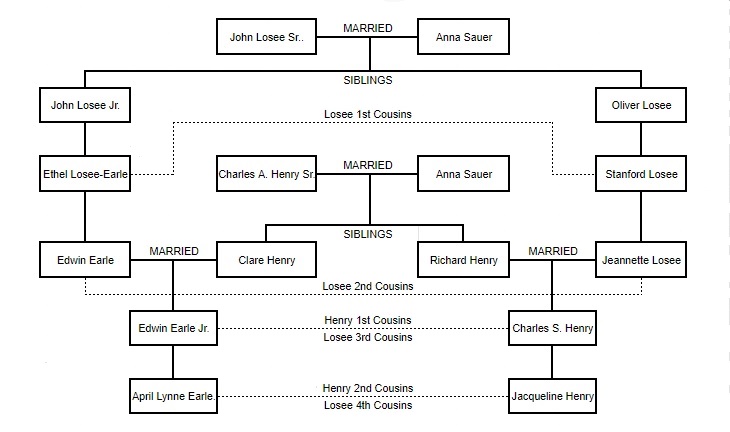
I could say Ethel was the foundation or root of my interest in genealogy but nope, sorry Ethel, it wasn't really her. For that honor, I point to my great aunt, Jeannette Alice Losee-Henry. Jeannette wasn't especially interested in genealogy, nor was she a central figure in my life. I never even really spent much time with Aunt Jeannette but it was at that reunion that I learned I was related to Aunt Jeannette in 2 ways. Yes, 2 ways. Blew my mind. 

I knew Aunt Jeannette was married to Grandma Earle's brother, Richard Henry, making her my great-aunt by marriage. But it was at that Losee reunion that I learned she was related to me biologically as well. She was my grandfather's cousin.  Mind blown. Jeannette was born a Losee. 

I couldn't get my head around it and it is what really started my research. I needed to understand how she was related to both my Grandma Earle AND my Grandpa Earle. I needed to visually see it on a tree. And neither Jeannette or my grandfather could draw it out for me. Grandma tried but I had to do it myself.

The revelation sparked me to inquire how the couples met. "So did grandpa introduce his cousin to grandma's brother or the other way around?"

The response I received was confounding. It wasn't until Richie brought Jeannette home to meet his parents, Great Grandpa Charles & Great Grandma Anna Henry,  that Jeannette's connection to my grandfather was brought to light. My grandparents were already married at the time. At Richie & Jeannette's engagement party, grandpa, who we all called Poppy, simple asked Jeannette what her last name was. To which he reacted with, "That's my mother's maiden name too."

The family sorted out the connection then, again, I had to figure it out on my own to really get it. So this confusing little diagram totally makes sense to me.

To achieve this goal of mapping out how Grandpa Earle was related to Aunt Jeannette Losee-Henry, I made several trips to the Freeport Memorial Library. I was told the Losee Family were early settlers of Freeport. Little did I know how early, but I digress. I thought the Freeport Memorial Library might have some more information for me. 

On my first research visit to that library, I was taken into what they called the History Room. While I waited for the librarian to pull some books for me from their closed stack, I wandered around the room with my Grandma Earle reading the plaques on the walls. 

I learned the room I was standing in was the original library building and that it was built as a Civil War Memorial. Up on a plaque, honoring the town's residents who died  in the Civil War, was the name Benjamin F. Losee. And so my first lesson in genealogy research was learned; that every answer leads to more questions. Now I had to figure out how Aunt Jeannette was related to Poppy AND how I must be related to Benjamin F. Losee. 

30+ years later, I am still at this genealogy game and I still have more questions before me.

Thanks, Aunt Jeannette.

#52ancestors

Wednesday, June 2, 2021

Ethel's Citizenship

There was a period in U.S. history that if a natural born U.S. woman married a foreign man, she lost her U.S. citizenship. 

It's true!

Starting on March 2, 1907, an American woman, by birth or naturalization, lost her citizenship when she married an alien. She thereby took on his nationality. She could regain her U.S. citizenship if and when her husband naturalized. His naturalization required a total of 5 years residency in the U.S. including 1 year of residency in the state of application and 2 years between his declaration of intent to naturalize and the submission of his naturalization petition.

On September 22, 1922 the Cable Act was passed. This Act made it so that women could no longer be naturalized through derivative citizenship; meaning that she herself had to apply for her own citizenship. She didn't just get it automatically when her alien husband naturalized. 

It also made it so women no longer lost their U.S. citizenship just because she married an alien. However, the women who had previously lost their citizenship due to marrying an alien were only made eligible to naturalized. They didn't just get it back. They had to go through the process of applying for citizenship.

On June 25, 1936, it changed again so that women who were native born U.S. citizens that lost their citizenship due to marriage an foreign man prior to September 22, 1922 could be considered a citizen again if she took the oath of allegiance AND her marriage was terminated by either death or divorce of her spouse. So in other words, she could be come a citizen on her own as long as that guy wasn't her husband anymore.

It wasn't until July 2, 1940 that those women who lost their citizenship through marriage between 1907 and 1922 could be considered a citizen again. She still had to take the oath of allegiance, but it didn't matter if her husband was dead or alive anymore, she could do it on her own. The one caveat being that she had to resided in U.S. for the duration of the marriage.

So that brings me to my great grandmother, Ethel Mae Losee-Earle. Ethel was born on St. Valentine's Day, 1896 in Freeport, Long Island, New York, where 8 previous generations had all been born after her 7th great grandfather, Edward Raynor settled the area in the mid 1600s.

By all accounts, Ethel never left Long Island. Maybe she ventured into Manhattan or up to New England for some excursion but she never traveled abroad. 

On June 5, 1915, she married Abram Thomas Earle in Freeport. Abram was born in Twillingate, Newfoundland which at the time of his birth was a British colony. Newfoundland only became a province of Canada on March 31, 1949. So when Ethel married Abe, she too became a British citizen. She had never been there. Never planned to even visit. Yet, she was no longer an American.

Now maybe in 1915 that didn't seem like a big deal but I wonder how she felt in 1920 when American women were finally able to vote and she couldn't.

Until very recently I had no reason to believe Abe had ever naturalized. I believed wholeheartedly that he had died a British citizen. Although, I don't know what becomes of your citizenship status when your place of birth changes its status like Newfoundland did by joining Canada in 1949. When Abe died in 1973 would he have been considered British or Canadian?

Ugh, well I don't have to answer that because, lookie here:

Abe naturalized on January 10, 1925, before my grandfather Ed was born in August of that year.

And guess what - - So did Ethel.

I was so happy to see her Certificate of Naturalization. I find the whole business of one loosing her citizenship so shameful. As if marrying someone outside of your national origin is a sign of disloyalty to your nation.

Love is love, people.

Monday, February 8, 2021

Burial Location Found through Social Media: Gersham Smith and Sarah Ann Garvey-Smith

 When I ran into a dead end, no pun intended, looking for the burial location of my 3rd great grandparents; Gersham Smith (about 1848 - 6 November 1905) and Sarah Ann Garvey-Smith (about 1851 - 31 December 1893), I turned to social media. 

I belong to a FaceBook group called Long Island History and I had recently seen a post there about small abandoned family cemeteries around Long Island. One man had posted a photo of cemetery he had stumbled across. Having no success in finding my couple buried at the well known cemeteries in the area, I replied to that post asking if anyone knew of small cemeteries around the North Bellmore area. One man replied that there was a small, old cemetery behind the Christ Alive Church on East Meadow Avenue in East Meadow.

The Christ Alive Church was once the area's Methodist Church. The Methodists constructed a new building across the street and slightly north of their old church but the cemetery behind the Christ Alive Church has a sign that reads: United Methodist Church Cemetery Est, 1859. 


Hmm. My grandpa was raise a Methodist and converted to Catholicism after he married my grandma. Religion is very fluid in my family history. Could it be grandpa's great grandparents were still Methodists back then? Hmm. Maybe.

Place names change over time. That is certainly true here on Long Island. Many of my early Long Island ancestors were settled in Freeport. Freeport has been known by a couple of names including Raynor South and Raynortown. The European credited with settling the area in 1659 was my 10th great grandfather, Edward Raynor, thus the former names of Freeport. 

I don't live in Freeport but my family has resided in the community and surrounding towns for over 350 years; towns including Baldwin, Bellmore, East Meadow, Hempstead, Merrick, and Roosevelt. All those places, at one time, had a different name. The area in which my Smiths lived was once known as Smithville South. Yeah, they have a couple of people named Smith living there. That area is now North Bellmore and part of East Meadow. So maybe Gersham and Sarah Ann were Methodists buried in East Meadow.

I visited the churchyard on Sunday, January 31, 2021. There were very few legible headstones but there were two for Smiths; Vera May Smith (about 1899 - 6 November 1918) and, in another section, Henry E. Smith (1877 - 1917).


I went home and found an email address for the Methodist Church across the street. A very nice woman named Marcella emailed me back that she would take a look at the Church's records as soon as she was in the office. With the current COVID pandemic, I don't expect anyone to be working full-time in any office anywhere everyday. If you are, God bless you.

Yesterday I received an email back with wonderful scans showing documentation that lot 73 of the cemetery belonged to a Gersham Smith; most likely my Gersham Smith.

Marcella is going to look to see if she can confirm the couple is buried there by checking other record books to see if services were held for either of their deaths. In the meantime I have learned that Henry E. Smith for whom there is a headstone in Lot 73 is likely the son of Gersham and Sarah who I have recorded in my research as Harry. So I am pretty confident that I have been to where my third great grandparents, Gersham and Sarah Ann Smith are buried.

CHECK.