Showing posts with label Census. Show all posts

Friday, June 30, 2023

Where Did You Go, Lydia?

I have been looking at my tree, considering what family stories I want to record and realizing that there are some ancestors I truly struggle finding any information on, and I kind of want to record that for posterity too; what I don't know and can't seem to discover.

My research into my maternal line I have done with little to no guidance. I am estranged from my mother. My maternal grandmother passed before I was born and my maternal grandfather didn't really discuss the past. Reluctant to talk about his family history, I didn't really dig into his line until after he died in 2004.

One year I set the goal to find the names of all my 3rd great grandparents. I did it. With most of the discoveries came dates of birth and death if nothing else about their lives. However, some of those dates escape me. One in particular that plaques me is the date of death for my 3rd great grandmother Lydia Marie McLean-Sharp. 

She was born on September 15, 1868 in Barnston, Quebec to Elizabeth Walker-McLean and Donald McLean. I know that from her baptismal registration in the Quebec, Canada, Vital and Church Records otherwise known as the Drouin Collection; a rather thorough resource of vital statistics given the time and place of their creation. She was baptized at the Church of England in Hatley, Quebec, not far from Barnston.

For the life of me I cannot find her date of death though. I have combed through those Drouin records a million times; page by page. Index be damned. Maybe there was some mistranscription of something. Page by page in the narrow time period she must have died in, I find nothing in any of the records for that church or any of the other churches where other relatives had their sacraments of baptism, marriage, and burial. I don't know where she went and it drives me batty.

I see her in the 1911 Census of Canada, listed as 38 years-old and widowed, although I believe she would have been 43 at the time. She was living with her two children, Mayme (my great grandmother) and Daniel James Sharp Jr. in the house of a cousin, Calvin Moore. Then no mention of Lydia again. I think she had to have passed before 1916 when her son Dan enlists in WWI and lists his sister as his next of kin.

Lydia was widowed on October 12, 1898, when her husband, Daniel Sharp Sr., 46 years her senior dies in St. Felix-de-Kingsey, Quebec. Yeah, he was 46 years older than her. 46 and a half years older. Don't get me started. It grosses me out too.

Lydia was young when she was widowed. Maybe she remarried? Moved away? Canadians have this great habit of retaining the woman's maiden name though, in their vital records and on their headstones. A headstone would have likely read "Lydia McLean wife of Daniel Moore." Even so, I still think she died before Dan Jr. enlisted otherwise I think he would have listed his mom as his next of kin. 

She had to have died young too, between 43 and 48. Did she? Where did you go Lydia? What record sets do I even look in? 

Friday, March 3, 2023

Never Trust an Index

I recently gave a presentation on getting started in genealogy research at a local public library. One of the lessons I stressed, there and to my summer students, is to really read the documents you find. Whether it be through a database or a physical document you obtained from a library, archive, or municipal agency, you have to really read it. Read it!! The details reveal clues to potential uncovering more documentation.

Additionally, never trust an index. Genealogical documentation has many layers of potential for human errors. There could be mistakes made when the record was originally created or it could just as easily have a error made when the record is transcribed into machine readable type. People have to type up the text of a document for a searchable index to be created. Wellllll....that is not entirely true. Now with artificial intelligence and its predecessor OCR (Optical Character Recognition), people don't always create the index. Although, people should be the final reviewers of those indexes.

For years and years I searched for my Grandpa Earle and his parents in the 1930 U.S. Federal Census with no success until I tried a search constructed with just the state, county, and household members first names - - no last name. And sure enough Abram, Ethel, Allen, and Edwin came up in New York, Nassau County, Town of Hempstead indexed as Carle, not Earle. And look at the image:


See the way that E is written? Totally looks like a C. And even soundexing searches wouldn't pick up that mis-transcription; if you could even call it a mis-transcription. Honestly, that is just shitty penmanship if you ask me. 

Another example of an error in the index comes from working with another researcher. She knew where the family should be living at the time the 1940 census was taken. When we look at the index page on Ancestry if clearly indicated the family was black and my client insisted that it could not be her family even though all the names and address matched. "Really? You really don't think it's not them?"


Of course it is them. If you open that image of the actual record you can clearly see that the family is listed as "W" as in white. 


Again, never trust an index. Look at the original record. Even if you don't think that could be your people, look anyway. 

Monday, December 19, 2022

52 Ancestors Challenge Week 51: "Perseverance" - Great-great Grandma Annette Hinch-Henry Survives Strife and Helped Others to do the Same

The word "perseverance" brings to mind my great-great grandmother, Annette "Anne" Hinch-Henry (February 22, 1868 - March 2, 1952). In fact, I feel like Anne's life would make for a good movie and I know exactly who I would have play her... Can you guess who?

...Julia Roberts! I think she looks a lot like her. I didn't get those genes.

Anne was born in Barnamelia, by Knockanna, Co. Wicklow, Ireland in 1868. As far as I can tell her mother, Jane Kavanaugh-Hinch died in about 1875 leaving 6 children ranging in age from about 10 to 2. I have not been able to find a death record for Jane in any Irish registers. In fact, many of the details I have about the Hinch family are vague at best. 

For instance, I don't know when Anne came to the U.S. from Ireland. Various census records note her arrival in 1886, 1887, and possibly 1890. I did find a record for a Jas Hinch or Hench arriving on June 6, 1885 aboard the H.M.S. City of Chester with 2 daughters, Anne 22 and Sarah age 20. Now her father James Hinch did have 2 daughters, Anne and her younger sister, Sarah, but the ages are off a bit, not that that ever matters. I do think that 1885 arrival date is correct though. It is said she came to NY from Ireland with her widowed father after the death of her younger brother; that could be them. As if the loss of her mother and a younger sibling weren't enough tragedy, her father James dies in the City of New York on January 29, 1886, not long after their arrival in the U.S. I can only assume that her paternal uncle, Charles Hinch, assumed a role of father figure to Anne.

Nine years later, though, her uncle Charles Hinch dies on January 24, 1895. That same year Anne married to Victor Henry on June 18, 1895, maybe with the hope of finally having some security and a family of her own. The following year she gives birth to their first child, my great grandfather, Charles Aloysius Henry. The couple has six children in all. Only 3 of which survive to adulthood. The 10 years between the birth of her first child and the death of her 6th child, again, seem to me wrought with tragedy:

  • March 26, 1896 - Child #1, Charles Aloysius Henry is born
  • December 8, 1897 - Child #2, Mary Anne Henry is born
  • April 6, 1899 - Mary Anne dies before her 2nd birthday
  • November 14, 1899 - Child #3, Jane Veronica Henry is born
  • July 10, 1902 - Child #4, Victory Henry is born
  • June 24, 1904 - Child #5, James Henry is born
  • July 16, 1905 - James dies shortly after his first birthday.
  • February 7, 1906 - Child #6, Robert Henry is born
  • February 10, 1906 - Robert only lives 3 days.

Oh but it gets worse. 

On June 23, 1907 her husband, Victor Henry, committed a murder-suicide. Being widowed with 3 small children (Charles 11, Jane 7, and Victor 4) would be hard enough but add to that the shame of losing a husband to suicide in a very public display must have been a horrendous weight to bear. To make matters even worse, Victor's victim was Anne's first cousin, her Uncle Charles Hinch's daughter, Mary Ann Hinch-Cassidy. Scandalous articles appear in local papers speculating that Victor was enamored with the Widow Cassidy if not outright having an affair with her. Mary Ann's death also left 3 orphaned children.

Anne had to find someway to financially support herself and her three children. A story shared by my grandmother's cousins was that initially she put her children into an orphanage. Where ever this home for children was, it was located near a beach. Charles, being the oldest child, saw that his siblings weren't being properly fed at this facility, so he would hide food from his lunch in his pockets, take it out to the beach, and bury it. Later, his siblings would retrieve the food so they would have something to eat. Anna learned of this and immediately brought her children home. She took on odd jobs, mostly cleaning for people. At one point she worked at Aquaduct Raceway in Queens cleaning at what is a pretty well know horse racing track. She also took in foster children which I am sure came with some money from the state as it still does today. In several census records I saw children other than her own living with Anne.

In the 1915 NY State Census, Anne had 6 children living with her; the three that we know are her biological children and Joseph (age 3), Frank (age 1), and Antonio (age 1) all listed as with the surname Henry. In the 1920 U.S. Census she had three "foundlings" in her care; George Hula age 4, and twin girls age 2, Marah and Mary Gericie. In 1930, Victor is the only one of Anna's children still living with her but they also had an 8 year-old "boarder" named Edward Reed.

My Great Uncle Bobby told me Edward died of appendicitis while in Anna's care. He recalled that his grandma, Anne, took Eddie to the doctor's office with terrible stomach pain and the doctor dismissed his ailment as an act; that Eddie's was just trying to get out of going to school. Apparently though, he was treated for appendicitis because according to his death certificate, Edward Reed died on December 7, 1937 at the age of 16 at Jamaica Hospital of gangrene following an appendectomy conducted on November 19, 1937. He is buried with Anne at St. John's Cemetery in Queens, NY. Anna signed his death certificate as his guardian and Uncle Bobby recalled Anne was devastated with grief at Eddie's death.

Edward, George, Marah, Mary, Joseph, Frank, and Antonio are just the 7 foster children I know of; I imagine there were many others.

Now burying one child is horrific enough, Anne buried 3 of her own babies and a foster child and goes on to outlive 2 of her own adult children. Both my great grandfather, Charles, and his younger brother Victor predecease their mother. On September 30, 1940, Victor drown at the age of 38, overcome in a storm while fishing with his brother-in-law Clarence Edsall (July 26, 1890 - March 30, 1955). My grandmother recalled the day her Uncle Victor died. She was just 11 when the police arrived at their door in East Hempstead, Long Island, now Uniondale, to inform her father, Charles, that Victor had died. 

My great grandpa, Charles, died on June 14, 1949 at the age of 53 from a rare form of cancer; cancer of the peritoneum. The peritoneum is a thin layer of tissue that lines the abdomen. It is believed he may have developed the cancer because of chemicals he was exposed to while carrying out his profession as a paint manufacturer.

Although I did not know my Great-great Grandmother, I know Anne must have been a strong woman with a gentle heart. She seems to have showered great kindness on the unfortunate, even though she herself was likely viewed as unfortunate. That's a nice legacy to leave behind; to survive strife and help others to do the same.

Monday, October 17, 2022

52 Ancestors Challenge Week 42: "Lost" - Research Stymied by Disasters, Part 1

This topic brought to mind the considerable number of records lost to genealogists due to fires and natural disasters. Loss of life is of the highest concern, of course, but these disasters can go beyond the destruction of buildings and landscapes to damage invaluable records and images of our cultural heritage. So many events like these have impacted and hindered my personal genealogy research that I am going to do this in 2 parts. Here is part 1:

1. The Destruction of the 1890 U.S. Federal Census
Who amongst us genealogists doesn't wish this record set had survived?? Any American genealogist quickly comes to learn about the destruction of the 1890 U.S. Federal Census. Often it as brushed off as the result of a fire but the truth is the 1890 census records sustain two fires; one on March 22, 1896 and another on January 10, 1921. Ultimately, though, it wasn't destroyed by a fire; it was destroyed by Congress in 1935.

The first fire, on March 22, 1896, was in the Department of the Interior's storage space in Marini's Hall on E street in Washington, D.C. That fire destroyed and/or damaged most of the special schedules; the ones related to mortality, agriculture, etc. The second fire occurred on January 10, 1921 in the Commerce Building in D.C. That destroyed about 25% of the population schedules and cause smoke and water damage to another 50%. The damaged records then sat in a warehouse until Congress authorized its destruction on February 21, 1933. The actual destruction didn’t take place until 1935.

Based on the existing aggregate data it represented a population increase of about 25% since the 1880 Census. That increase was in part the result of a tremendous amount of immigration that took place between 1880 and 1890. It also would have reflected a great amount of westward migration. Not to mention that it was the first census to be tabulated by a machine known as Hollerith’s Machine. Technology! In it, respondents answered questions about immigration, naturalization, military service, and the maternity questions regarding the number of children born and living.

Less than 1% of it did survives. Perhaps you are lucky enough to find your ancestors in the fragments that exist from Alabama, Georgia, Illinois, Minnesota, New Jersey, New York, North Carolina, Ohio, South Dakota, Texas, and the District of Columbia. Give it a shot. Take a look. My family isn’t in there but maybe yours is. About 6,000 names are listed.

There have been far too many instances in my own research when making the jump from the 1900 census back to the 1880 census has proven to be impossible. 20 years is a lot of time for lives to change drastically; marriages, name changes, deaths, loss of infants, relocations, etc. I can attest that is is possible to miss something you never ever had. 

2. U.S. Military Personnel Records, NPRC Fire of 1973
Ever try to get your ancestor's records of service from WWI or WWII from the National Archives and Records Administration (NARA)? No luck, right? Yeah, me too. 

That is because on July 12, 1973, a devastating fire ripped through the 6th floor of the National Personnel Records Center (NPRC) in St. Louis, Missouri. Of the 22 million individual files that were stored on that floor alone, approximately 16–18 million Official Military Personnel Files (OMPF) were destroyed. This vague number is due to the fact that the records had never been indexed, microfilmed, or duplicated. There is no database or registry to check on what was lost. Each file was as specific and unique to the individual as was their military service from basic training and burial.

In 1956, the Department of Defense constructed its six-story, state-of-the-art archives building outside of St. Louis to serve as the NPRC, which was formed in an effort to streamline federal agencies archival processes and house service records of all federal civil and military service personnel.  By the time of the fire in 1973, the NPRC had amassed a collection of about 52 million individual personnel records. The building's major flaw was that it lacked a sprinkler system. Yeah, for real. That seems ridiculous to us now but at the time of its construction there was a strong fear that such a system's potential to cause water damage was more likely than the occurrence of a fire.

That fire, though, burned for over 22 hours. Forty-two fire districts worked together to contain the fire to the 6th floor. Fortunately, no one was killed or injured, but the fire caused the roof to collapse and the heat was so  prolonged and intense that metal shelves and filing cabinets melted. Water and debris were everywhere. Records were reduced to ashes. It is estimated that 80% of the Army personnel records for those discharged between November 1, 1912 and January 1, 1960 were destroyed as well as 75% of the Air Force's personnel records for those discharged between September 25, 1947 and January 1, 1964 (with names alphabetically after Hubbard, James E.). To this day the cause of the fire is unknown.

Once extinguished, though, the painstaking effort of restoration began. The July heat and humidity in St. Louis created circumstances ideal for mold growth and thus approximately 90,000 cubic feet of documents needed drying immediately. Ultimately, vacuum chambers in the nearby McDonnell Douglas Aircraft Corporation plant were used to squeeze literally tons of the water out of the salvaged records. 

The NPRC’s work to restore and reconstruct these records continues to this day. The Center’s treatment labs use the latest technology to make remaining damaged files legible again. However, the sad reality is that the vast majority of records were reduced to ash. No technology can make ashes legible. Typically NARA can prove a veterans eligibility for benefits or next of kin entitlements from auxiliary records not originally stored with the rest of the files. Unfortunately, auxiliary records only tell part of the story the. The fuller history of an individual's military service is often just lost forever.

3. The New York State Library Fire of 1911
On March 29, 1911, a fire in New York's State capitol city of Albany, destroyed an enormous amount of historical and genealogical records. The New York State Capitol building is currently the seat of New York's state government, but in 1911 it also housed the State Library. The fire started in the Assembly Library. Fueled by the abundance of paper, some dating back to colonial New Netherland, the fire quickly spread down the hall to the nearby State Library.

Unfortunately, the Library and all its materials were scheduled to move to a new building on January 1, 1911 but due to construction delays all materials were still in the Capitol building when the fire occurred. The more famous, horrific Triangle Shirtwaist Co. factory fire happened in Manhattan just 4 days before the Capital fire. The conflagration of these events led to the a strengthen of building codes and safety laws in New York State and eventually nationwide.

Nearly half a million books, stacked floor to ceiling on pine shelves, were destroyed as well as over 300,000 manuscripts and the entire card catalog consisting of nearly 1 million records. In fact, only about 7,000 books and 80,000 manuscripts were saved through the heroic efforts of several librarians.  Present day researchers of New York history owe a great debt to the librarians who risk their lives running around the burning corridors to save books and documents.

Like with the aforementioned fires, as soon as the building was safe to enter, the recovery effort began. And again, even the many volumes that escaped the flames were severely damaged from smoke and/or the water from the firefighters efforts to extinguish the fire.  Researchers and librarians often come across tangible evidence of the fire in the form of documents charred around the edges or shriveled from water damage. Among some of the important documents saved was the original Emancipation Proclamation, written in Abraham Lincoln’s own hand.

With my deep New York roots, it is hard to estimate what more I might be able to learn about my family history if those resources had they survived. By the way, according to Capitol lore, the ghost of sole victim of the fire, 78-year-old night watchman, Samuel Abbott, is said to haunt the Capitol’s fourth floor where his body was found. 

Monday, September 12, 2022

52 Ancestors Challenge Week 37: "High and Low" - Not in the 1950 Census

Every presentation I attended regarding the recent release of the 1950 U.S. Federal Census has gone on and on about the great lengths the government went to ensure that every household and individual was recorded accurately. Welp, my dad is not there, nor are his parents, or his paternal grandparents who were, by all accounts, living together. I have searched "High and Low" for my father in the 1950 census with no success.

I know the exact address they were living at in 1950, 15 Berkshire Road, Merrick, New York in Nassau County. My grandfather bought the house shortly after he returned from service in the U.S. Navy during World War II. I believe he purchased it in 1947. He lived there until his death in June of 2001. In fact, my grandparents met on that block.

The story goes that there was a terrible blizzard while my grandmother was at her sister's house on the very same block. My grandfather went over to help his neighbor, my grandmother's brother-in-law, shovel and that is when they met in the great blizzard of December 1947 which began on December 26. You can read the Life magazine coverage of the storm here in this blog post by Ben Cosgrove: https://www.life.com/nature/snow-blizzard-of-1947-photos-of-new-york/  My grandparents were married less than 2 years later in February 1949. In late December of 1949, they had their first child, my dad.

Now, my grandmother's sister, brother-in-law, and their two eldest children are on the 1950 census as are all the even numbered houses on the block. But the odd numbered homes aren't there.

Everyone I have asked to look have told me, "Well, they lived very close to the boarder of the next enumeration district (ED)." Yes they did. They are very close to the southern boundary of ED 30-338, in Nassau County, New York. However, the block south of them is recorded in ED 30-338. The house directly behind my grandparent's is there, where expected, in ED 30-338 but not my grandparents and not any of the other odd numbered houses on the block.

Now, let's for a minute consider that perhaps they weren't living where I know they were. Maybe for that month they were all living somewhere else. I don't know. Let's pretend the house was being renovated and they were staying with some friends somewhere in a whole other state. Didn't happen but let's pretend.

Where are their neighbors? Where are the odd numbered houses on their block? Not there. Not in ED 30-338 of New York; not in any of the surrounding EDs either.

I am 100% convinced that the people I so eagerly waited to see recorded in the 1950 census (my dad, his parents, and paternal grandparents) were missed. 

Mistakes were made, people. Mistakes were made!

Prove me wrong. I dare you. And I would be eternally grateful if you could find them.


Thursday, August 25, 2022

52 Ancestors Challenge Week 34: "Timeline" - My Review of MyHeritage

The theme for this week, Timeline, immediately makes me think of the Family Tree Timeline feature in MyHeritage so I am going to take this opportunity to write a review of the genealogical research website. I have poked at it in the past but I was never had a subscription before this year and quite honestly, I do not think I will continue it when my membership expires. 

Don't get me wrong, it is a good website. It has many resources but it doesn't strike me as having more than Ancestry or anything all that different in terms of records I need to enhance or advance my family history research. It does, however, have some truly amazing, fancy, features some of which I will highlight in this post. I just pay so much for my Ancestry membership already and I use Ancestry so much with clients and students. I can't really afford to keep up with 2 sites. I prefer Ancestry.com. Truth be told, I find the abundance of fancy features on MyHeritage a bit overwhelming even though they are really cool. Maybe if I had started with MyHeritage it would be my go-to.

So let me tell you about some of my favorite features at MyHeritage:

1. DNA: For one, MyHeritage allows for the upload of raw DNA from other direct-to-consumer DNA test providers which AncestryDNA and 23andMe do not allow. By uploading your DNA to MyHeritage, one can increase the number of potential matches that they have. You never really know where that one needed match will be that will help you bust through your brick walls. One can also take a MyHeritage DNA test as they too sell a direct-to-comsumer DNA testing kits. In MyHeritage I have over 12k DNA matches. A lot of people use this site for DNA research. I tell all my adoptee clients to use it.

They also have DNA tools like auto-clustering and a chromosome browser which Ancestry does not have at present. A chromosome browser helps you view segments of DNA shared between you and multiple DNA matches which can help point to a common ancestor. Auto-clustering is much like application of the Leeds Method, if you are familiar with that, its a tool that organizes your DNA Matches into clusters or groups that likely descended from the same common ancestor.

2. PHOTO TOOLS: MyHeritage's photo tools have gotten a lot of publicity in the past couple of years since it added the tool to animate photos. Below is a head shot of me animated. It is very cool when applied to photos of long deceased ancestors that you may have. However, I find something kind of unnerving about it when applied to photos of recently deceased relatives. Kind of creeps me out. Fun feature though, not to mention the other photo enhancing and editing tools they provide. Ooo, but the creepiest photo tool they have, if you ask me, is DeepStory which actually can make your family photos speak. Yeah, worth checking out but not something I need on the daily.


3. FAMILY EVENTS: I am going to miss this feature when I say goodbye to MyHeritage. This is basically a calendar of family birthdays and anniversaries based on the information you have put into your own family tree. You can add to it holidays from an assortment of countries and even display dates according to the Hebrew calendar.


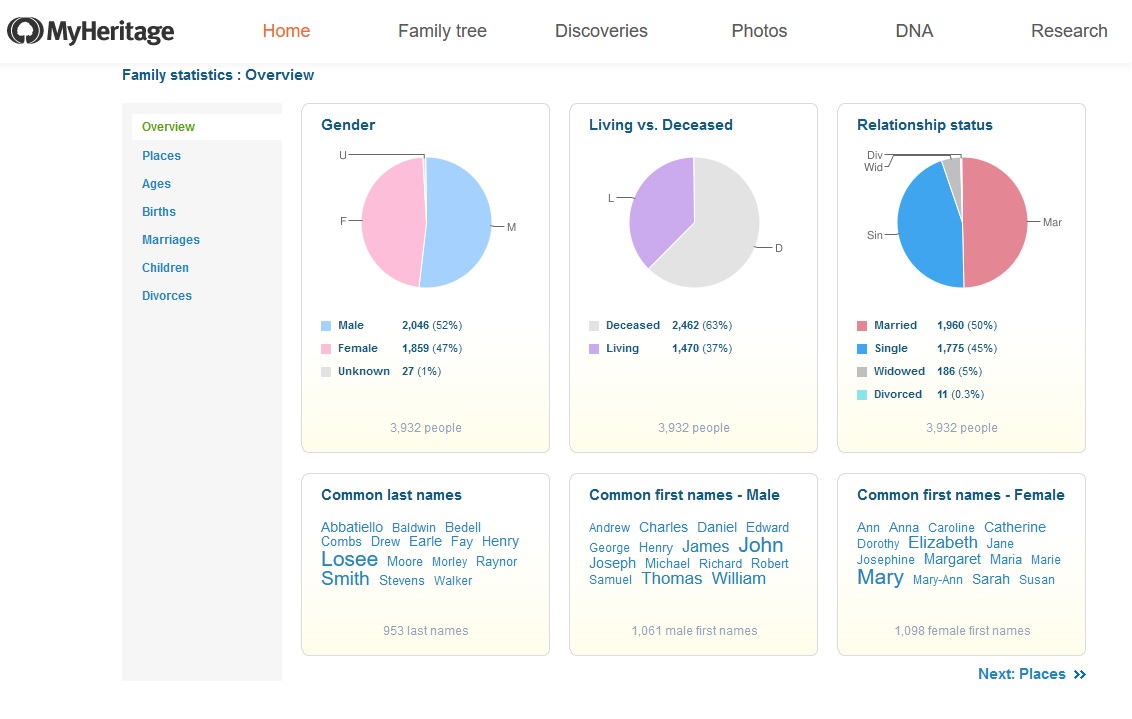
4. FAMILY STATISTICS: This is a neat feature that presents aggregate data from your tree. Just fun factoids like I haven't set the gender for 27 individuals in my tree, thus 52% of my family tree is male, 47% is female, and 1% is of an unknown gender. The most common first name for males in my family tree is John and for females is Mary. 

And ta-dah, 5. TIMELINE: The Family Tree Timeline can help you visualize your ancestors’ lifespans, including whose lives overlapped and what major world events they lived through. It is a visual representation of the direct ancestors of one individual from your family tree, you are typically the default person. The lifespans of these individuals are presented on a bar graph. By default the Timeline shows 4 generations, from you to your great-grandparents. However, you can choose to display more or fewer  generations.

Each person’s name, profile photo, and age appear on a colored bar. If the individual is deceased, their bar is rounded on the right and their age at the time of their death appears at the far right. The bars representing living individuals are squared on the right and their current age appears there. If the date of birth or death is unknown, the bar will be faded towards the birth or death date, ending at an approximation of the time of their birth or death.

However, what I wish Timeline did was show the overlap of lifespans for family groups, not just direct ancestors. I'd like to see my siblings, cousins, aunts/uncles, etc. represented on a timeline. I think it would help my research in a lot of way. For example, such a feature might help pinpoint a date on which a group photo was taken. For example, I have a group photo with 10 people in it. I can identify 9 of them. I know it has to be taken before person A died and after these six kids were born. Maybe I could figure out that 10th person if I could see who was alive at the same time.

ABOUT THE 1950 CENSUS: MyHeritage came up with this awesome tool shortly after the recent release of the 1950 U.S. Federal Census that kind of incorporates their Timeline capabilities. Under "Research" there is a new link for Census Helper. It generates a list of individuals in your family tree who are likely to be found in the 1950 census. In fact, it does this for any U.S. census you're researching in as well as censuses for Canada, Ireland, Scotland, Denmark, Norway, France, and England & Wales!

Again, MyHeritage has great features which if you have never explored before, you should!

Tuesday, June 28, 2022

52 Ancestors Challenge Week 26: "Identity" - Great Grandpa Almond Desjardins or Albert Gardner

In general my family lines possess rather short surnames, easily pronounceable by those of English extraction. Hell, most of them are English in origin. I don't see a lot of Anglicizing in my family tree. 

Looking at my great-great grandparents and their surnames, most of them don't even have more than 6 letters to them. There is Earle, Samms, Losee, Henry, Hinch, Sauer, Gray, Smith, Sharp, McLean, Fay, Joyce, Prince. Oh, ok, there is Krantzel! 8 letters in that one. Through generations Krantzel was cut down from Krantzlein. I guess that is Anglicized but then there is Desjardins. 

Desjardins became Gardner. Yeah, not even close in spelling but rather its Anglicization was based on its meaning. If you have taken high school French you can probably tell Desjardins means "from the gardens." Likely that means that somewhere back in time I descend from some Frenchman with a green thumb. 

Any of you reading this who are Canadian will probably associate the name Desjardins with different green stuff - - money! Although, Canadian money comes in an array of colors really. The Desjardins Group is a Canadian federation of financial services and credit unions, the largest in North America. It was founded in 1900 in Lévis, Quebec by a man named Alphonse Desjardins. I have Alphonse Desjardins in my family tree. That was my great grandfather's brother's name. Likely no relation to bank founder though. I mean not close enough a relation to think they are just going to give me money without expecting it to be paid back with interest.

My great-great grandfather, Damas Desjardins, came to the United States from Montreal, Quebec, Canada in the early 1880s. I don't have any information about his immigration but according to my great-great grandmother's naturalization papers, the couple married on May 14, 1884 in New York City, so Damas was in New York before then.

In Damas's obituary from the Patchogue Advance in October of 1911 it states that "Mr. Desjardins was known to his friends here by the name of Gardiner, an Anglicization of his French family name."

His son, my great grandfather, also used Gardner as his surname. However, I do believe my great grandfather used his names to play with his identity. 

Great grandpa was born Almond Desjardins in Long Island City, Queens County, New York on September 21, 1891. He died on February 11, 1946 in the same county but known as Albert Gardner. 

There seems to be no official documentation of a legal name change for him which, based on the time period is not surprising. Names could be pretty fluid back then before Social Security. Lack of official documentation of the name change has also resulted in lots of confusion including a fellow genealogist who handing me a photocopy stating, "This article is about you great grandfather." Well sure the subject of the article, dragged into court for abandonment of his wife and children, had the same name as my great grandfather but my great grandfather died 2 years before that newspaper article was printed.  She whipped that paper out of my hand and tore it up with a besmirched look on her face. Sorry, not my Al.

The first record I have for great grandpa is the 1900 U.S. Federal Census in which he is recorded as Almod Desjirdins living at 332 Hopkins Avenue in Queens, NY. The street no longer exists by that name but I believe it was in the Astoria section of Queens.


I discovered several newspaper articles from 1906 & 1907 in which great-grandpa's early brushes with the law are described in detail. Here he is identified as A. Gardner, Almond Gardener, and Almond Gardner.

December 19, 1906
Brooklyn Daily Eagle

Astoria Pastor Robbed
Sneak Thieves Raided the Parsonage and Stole All the Children's Christmas Gifts

With the rounding up of gangs of hoodlums in the Astoria section of Long Island City comes the news of the robbery on Sunday night of the home of the Rev. W. L. Darby, pastor of the Presbyterian Church, in that place. It was while Pastor Darby was conducting services in his church, a short distance from his home, at Franklin street and the Boulevard, that the culprits got into the house through a kitchen window. All the family were at church and the intruders were free to ransack the house.

Among the articles carried off was a bundle of Christmas presents which the pastor and his wife had purchased for their children, relatives and friends. In their search, however, they overlooked $20 in cash which was in a bureau drawer which they rifled.

More than a dozen robberies have occurred throughout that section within the past month, and they all bear the impress of the sneak thief. In consequence sundry gangs that loiter around the village with no visible means of support are gradually being placed out of the way of temptation for the winter, and five more suspects were added to the bunch yesterday when police rounded up and captured A. Gardner, 16 years old, of 92 Sanford street; James Kidney, 16 years old, of 50 Mills street; Frank Donnelly, 15 years old, of 140 Broadway; James Sullivan, 20 years old, of 137 Ridge street, and Nicholas Donato, 15 year old, of Ridge street. This crowd had quit their homes and were living in an old building owned by the Joseph Wild Rug Company. They were charged with trespassing ad were held until their recent prowlings can be investigated.

November 8, 1907
Brooklyn Daily Eagle

Patchogue Lad in Trouble
He is Charged with Stealing Brass from Vacant Houses in L.I. City

Almond Gardener, 16 years old of Patchogue L.I. was arrested by the Long Island City police last night, and back of his arrest is an interesting story.

Young Gardener comes of a good family. He has an industrious brother living in Long Island City, and when he left Patchogue several days ago, he took up his residence with that brother. On Wednesday night two unoccupied frame houses, 86 and 88 Main street, Long Island City were broken into and damage done to the extent of $200. The damage was due to the desire of the marauders to get possession of certain pieces of brass in the plumbing work.

Unfortunately for the guilty parties, their first visit to the buildings resulted so successfully that they returned last night, and one of them was caught. The prisoner described himself as Almond Gardener of Patchogue. As Detectives Hufman and Ebbers of the Astoria Precinct have discovered where the brass pieces were sold for 55 cents, they expect to arrest Gardener's companion.

The police say that about a year ago Gardener and another boy names James Kidney were found sleeping in buildings near the rug works in Astoria. They were arrested and committed to the Catholic Protectory. Mrs. Gardener finally got her boy out of the institution and also succeeded in having his companion released. The Gardener family had resided in Astoria but moved to Patchogue before the boys were let out. They were taken to Patchogue from the Protectory, but after behaving themselves for about four months, the pair cut loose. Kidney was the first one to incur the displeasure of Mrs. Gardener and he was sent away. In three weeks young Gardener packed up his grip and started out to find a place with more life and go in it, and now he awaits the action of the courts.

November 8, 1907
Brooklyn Daily Star

Gardner Fell From Grace
Patchogue was too Slow so he came back to L.I. City
And got into trouble again - charged with burglary in Astoria
Tale of a big-Hearted Mother who tried to reform two bad boys and what came of her efforts
 
About thirty cents in cash and the prospect of a term in some penal institution is the reward Almond Gardner gets for taking the leading part in a burglary in Astoria on Wednesday night that resulted in theft of over $35 worth of lead pipe and plumbing fixtures and damage to the building which $100 will not pay for.
 
Gardner is the lad who was sent away to the Catholic Protectory in Manhattan about a year ago because he and another boy, James Kidney, persisted in sleeping out night in the stables and outhouses, rather than stay in the soft, warm beds that their homes provided
 
Gardner comes ...illegible... the good influence of a comfortable home, and seems to prefer the excitement of the under-world to obeying his parents.

After he had been in the Protectory for a few months, his folks moved from Astoria to Patchogue, and his mother, thinking that life in a country village would offer fewer temptations to evil doing, managed to ensure his release from the institution.
 
Took Both Boys Home
 
When she went over to Manhattan to get her boy, her attention was attracted to young Kidney, who looked pale and emaciated as the result of his confinement. Her mother heart was touched and she begged to be allowed to take Kidney home with her too. Kidney has no mother having been living with an aunt.
 
She took both boys with her to Patchogue and set to work to reform them. Kidney lasted about four months before he fell from grace. He could not stain the strain any longer, so he stole from his benefactor and fled out into the alluring world.
 
Gardner Lasted Longer
 
Gardner clung to the paths of rectitude with commendable tenacity up to about three weeks ago. Then he begged to be allowed to come to Long Island City to visit his brother who lives on Eighth street. Once here he became fascinated with the old life again, and began to consort with evil companions.
 
The climax came when he and another boy, wo has not yet been arrested, tore boards off one of the rear windows of the houses at 86 and 88 Main street and forced an entrance. They tipped out all the lead pipe they could carry and took away six sewer traps. This stuff they sold to a junk dealer for fifty-five cents, It cost new about $25. A plumber will probably charge over $100 to repair the damage.
 
Not content with this escapade, the boys came back later on to get more loot but they were frightened away. Detectives Hufman and Ebers were put on their trail with the result that Gardner was caught Thursday evening.
 
He readily confessed to the part he played in the burglary and said that it was no use for him to try to be good, anyway. He was arraigned in the Fifth street police court this Friday and held for the Grand Jury at $1000 bail.
 
December 21, 1907
Brooklyn Daily Star
 
Sing Sing for John Miller
Long Island City Man who Swindled Magnus Larsen sent up on Suspended Sentence - Five Other Given a Chance to Reform

 
County Judge Burt Jay Humphrey was very lenient with all but one of the six men who were brought before him this Saturday for sentence. Suspended sentences were handed out as Christmas presents to Henry Purse, Frank Schowsky, Almond Gardner, Joseph Daley and Joseph Casenza, and it may be safely said that few Christmas remembrances found in stockings of Santa Claus' large array of friends will be appreciated more than these tokens of judicial leniency.
...
Almond Gardner, a former Astoria boy whose folks now live at Patchogue took a quantity of lead pipe and brass sewer traps from a house belonging to George B. Ruthman on Main street last November. He is only seventeen years old and promised to behave.
... 
 
As mentioned in the above articles, by the 1910 census, the family has moved out of the city to Patchogue, Long Island in Suffolk County, New York. Here with the household, great grandpa is listed as Elman DesGardin.


On June 5, 1917, great grandpa registered for the WWI draft out in Kansas City, Missouri where he is registered as Albert Gardner. I know it is him because the birthdate matches, it states he was born in New York, and he was known to be a painter. Also by 1917, his father, Damas, was deceased and thus he would have likely been financially supporting just his mother.


After finding his WWI Draft Registration, I went looking for other military documents and I came across one that is out of sync with this timeline I am building but perhaps significant to understanding of his character and development of identity.

This record is from the U.S., Army, Register of Enlistments, 1798-1914 on Ancestry.com. It shows an Albert Gardner who enlisted in the U.S. Army on November 19, 1910 who was from New York and was 21 years and 1 month old at the time of his enlistment. My Albert would have been 19 years and 1 month on November 19, 1910 but I still think it may be him in this record because it indicates he was in the 3rd Calvary which is what I think it says on his WWI Draft Registration Card above. However, this record shows he was dishonorably discharged from Ft. Sam Houston in Texas on July 17, 1911. I don't know what all the notations below mean but maybe someone reading this does.


During the enumeration of the1920 census, I think he may have been residing in Oklahoma City, OK as I have found an Albert Gardner of the appropriate age listed as a printer at an office. The penmanship is rough and perhaps he was still actually working as a painter.

By September 1922 he is back in New York where he marries my great grandmother, Mary Elizabeth "Mayme" Sharp on September 5.


If you examine the above image closely, great grandpa reports his name to be Albert Gardner. His father was recorded as Thomas, not Damas Desjardins. Damas sounds like Thomas. Albert's mother is listed as Mary Desjardine although her real first name was Malvina and her maiden name was Ethier. I wonder if these errors are a result of the clerk's confusion or was it that Albert/Almond was reporting what he thought would be easiest for the clerk to record. I mean really, what did the clerk need to know. The couple did not have to produce documentation to verify these details. So it says Mary. Whateve...

From that point forward, including the 1925 New York State Census, and 1930 & 1940 U.S. Federal Census records, I only see him recorded as Albert Gardner. In all those records he is, married with children, living in Queens County, New York.

I discovered that at the time of his death on February 11, 1946 he was a resident of Creedmore Hospital, an institution for the mentally ill, in Queens, New York. He died of a heart attack but according to his New York City Death Certificate he was a resident of the hospital due to a diagnosis of schizophrenia. 

Schizophrenia is a very serious disease that involves far more than just hallucinations and talking to people that aren't there, which is so often how it is depicted on television and in movies. However, I wonder if the fluidity of his name throughout his lifetime was really just a result of the family's interest in Anglicizing their names to sound more American or if the name changes had something to do with his brush with the law or his general mental well-being. 

Often with the fluidity of name comes the question of how to record someone, by their birth name or by the name they went by. Personally, I believe a person should be recorded by the name they chose to go by with the researcher's awareness that their subject may appear with different names in their records.

Monday, June 6, 2022

52 Ancestors Challenge Week 23: "Mistake" - 3rd great grandparents, Lawrence & Bridget Fay

For awhile I had a cousin who lived in Saugeries, New York. Around the same time she lived there, I discovered that my maternal grandmother's family lived in Saugerties from the mid-to-late 1800s. It was a bit of surprise to me really. My maternal grandmother died before I was born. Thus, I have little family lore regarding this branch of my family. I think of them as my Irish immigrants who settled in New York City, though. But oh contraire mon frère. 

My 3rd great grandfather, Lawrence Fay (About 1829 - December 23, 1879), settled in Saugerties, Ulster County, New York, probably in the 1840s. He may have been a pre-famine Irish immigrant. I'm not sure as I have not been able to confirm his immigration date or where in Ireland he was born. 

The Great Famine occurred in Ireland between 1845 and 1852. During that time more than 1 million Irish died of starvation caused by phytophthora infestans, the fungus that invaded the potato plant; a staple of the Irish diet.

Lawrence was absolutely living in Saugerties at the time of the 1850 U.S. Federal Census. Pre-children, here Lawrence is listed with his wife, Bridget, living with a group of people that I don't know as being related.


The couple had 7 children. The oldest of which was my great great grandfather, Michael Fay (October 1852 - January 13, 1915).

I can't find much about Lawrence and Bridget's lives in Saugerties but I did find Lawrence listed in the 1880 Mortality Census, meaning he died before May 31, 1880.


If you find a relative in a Mortality Schedule you get so much information.

I have underlined my Lawrence in red but will transcribe the information as well below.

Fay, Lawrence. 
Age: 60. 
Sex: Male. 
Race: White. 
Marital Status: Married. 
Birthplace: Ireland. 
Father's birthplace: Ireland. 
Mother's birthplace: Ireland. 
Occupation: Blacksmith

Month in which the person died: December. 
Cause of Death: Chronic Bright's. 
How long a resident of the county?: 1
Place of Death: 445 W 40
Attending Physician: H.D. Joy

This information led me to a death certificate for Lawrence in the City of New York, not in Saugerties. However, his Manhattan death certificate indicates he is buried in Saugerties. In the red circle below I think it says Saugerties Ulster Co. He died on December 23, 1879 and was buried on Christmas Day. I didn't think Catholics buried on Christmas Day but the certificate says buried 25 Dec.

This find prompted me to look for his wife's, Bridget's, death certificate in the City of New York. She too is buried in Saugerties. She died on March 3, 1892.


Okay so we got this right? 
Lawrence Fay, age 60, died December 23, 1879.
Bridget Fay, age 60, died March 3, 1892.

Lookie here though. Their headstone at St. Mary of the Snows Roman Catholic Church in Saugerties, New York. That says Lawrence Fay Died 1880 aged 65 yrs Bridget Fay Died 1890 aged 60 yrs.


Mistakes were made people. Mistakes were made.

How these mistake were made I am not sure. I figure someone loved them enough to put up a stone long after this couple died and just gave the stone carver whatever information they thought they knew. Still...its a gesture of love and I am grateful there is a marker there, even if it isn't accurate.

Saturday, April 2, 2022

Newly Available Records: 1950 Census & NYC Vital Records

Some exciting things have happened in the last 2 weeks. One of course has been the much awaited release of the 1950 U.S. Federal Census. The other came as a great surprise to me, the release of the New York City's historical vital records online.

Yes, that is right. On March 15, 2022, the City of New York released their historic vital records online, for free, searchable from home for download and print - for FREE. https://a860-historicalvitalrecords.nyc.gov/

The index to these records have been available online for a very long time. Compiled by the Italian Genealogy Group and German Genealogy Group, the index is available on their respective websites, in Ancestry.com, and through FamilySearch.org. 

In the past I would rely on the FamilySearch.org index more often than not. For several reasons really. One, it was a more robust index record. It showed much more than just the name of the individual, county, and date of event. The FamilySearch index record showed the name of the individual, the county, the date of event AND often the name of the persons' parents, addresses, etc. depending on the type of record. Secondly, though, if you went to a Family History Center you could view the images of the records for free there, just like you can at home now. There I could view and print the records I wanted without traipsing into Manhattan. One could go to the New York City Municipal Archives at 30 Chambers St. in Manhattan and look at the vital records there. When I started doing that the records were on microfilm. Then they migrated them to digital images. I would scroll through microfilm there for hours though making wonderful discoveries. And I could look for free and transcribe the record by hand for free. In-person though I could also purchase a copy for a reduced price from ordering a record. I believe ordering online most recently had cost me $18.50. In-person it cost me $11, I think. Sometimes it was worth the trip but when you calculate in the cost of taking the train or driving in and parking, sometimes I'd just order the record but it was far too expensive to just guess and order something that was not for your person.

Now, vital records include birth certificates, marriage records, and death certificates. These records vary in date range based on the type of record.

Birth Certificates: 1855-1909
Marriage Certificates: 1866-1937
Death Certificates: 1866-1948

But don't let those start dates deceive you. Record keeping in NY did not really take hold until the 1880s. Those earlier dates reflect records that exist but it wasn't required by law to register birth, marriages, or deaths in New York State until June of 1880 for deaths and sometime in 1881 for for births and marriages. 

Vital records are typically managed by the state. Except in the instance of New York City. They are the only entity in the entire country that manages their own vital records, Sure city and town clerks might also have a register of vital events that occurred in their town but the documentation is handled by the state (except for NYC). 

One has to know where the event took place to know where to order the appropriate certificate from. Just because your relative lived their whole life in NY doesn't mean they couldn't have died on a road trip to New Jersey or while away on vacation in Florida.

So this has been very exciting to browse and download records from the City of New York for my dead people. Most of the documents I had already but not in digital format so I have been finding them online, downloading the records, and then converting them to jpegs and attaching them to my family tree on Ancestry. 

Now the 1950 census release was not a surprise. We have been waiting for that for 72 years. In the U.S. we take a census of the population every 10 years, on the years ending in "0". However, those records are not released to the public for 72 years. The aggregate data is published early on, telling us how many people live in the country breaking it down by locations, age, sex, and race. The actually census records themselves, listing residents by name, does not come out until 72 years after the record was made. That is really a measure of identity projection for the citizenry. 72 is life expectance, although that age is really increasing in our time, but still they figure in 72 year most of the people recorded in a specific census will likely be deceased and if not, they certainly will not be living with the same family set.

I was so jazzed to look for my father in the 1950 census. He was born in 1949 so he should be in there living with his parents who were married in 1948. Well - - I can't find them. 

I have found their block. I have read through every page of their enumeration district and multiple surrounding districts but there is no entry that I can find for their house; not even a note that says "no one was home." Funny as that sounds, "no one was home" is a common entry on the pages of the 1950 census.

In fact, I am offering a reward for anyone who can find my father, his parents, or his paternal grandparents in the 1950 census because I give up. I know, I know, it's only day 2 of having access to the records but I have had so much success finding others that I can't with dad no more.

The first step is to know where your people lived. Easier said then done, I know, but some of our living septuagenarians (those 70 and older, well, 72 in this case) are in these records.

If you have a potential location you can look up the Enumeration District (ED) on a map and see the ED number. My grandparents lived in Merrick, New York, which is in Nassau County. Looking at a map clearly showed their block in ED 30-338.


ED 30-338 is a 46 page document. Once in the correct ED, you can through in a surname and it might take you to the correct page of the census. That is what happened for me and finding my Drew cousins who lived across the street from my grandparents.


But no Earles show up. Either they were somewhere else that we don't know about - but I've looked in other EDs and areas of Nassau - or the census taker skipped that side of their street. As through all of time, mistakes were made, people.

Those images above were taken from https://1950census.archives.gov/ 

Go there. Give it a shot. See if you can find your people.

I have found both of my maternal grandparents (not yet married to one another), Grandpa Earle's brother, 3 out of 5 of my Grandma Earle's siblings, one of Grandma Earle's sister-in-laws, Grandma Earle's mother and grandmother, and a researching friend's family.

Today I plan to find my Grandma Earle's sister Ann, her brother Charlie, Grandma Gardner's sister Ann, and maybe Grandpa Gardner's sister Lois.


Monday, February 7, 2022

52 Ancestors Challenge Week 8: "Courting" - great-great grandparents, Daniel Sharp and Lydia McLean-Sharp

Last week I wrote about my great-great grandfather, Daniel Sharp (1822-1896), and his maternal line, the Moore Family of Londonderry, New Hampshire. This week's theme of "Courting" brings me back to Daniel.

Daniel Sharp was born on March 18, 1822 to Annie Moore-Sharp (1782-1868) and Peter Sharp (1783-unknown). His second wife, my great-great grandmother, Lydia McLean-Sharp was born on September 15, 1868. Oh yeah, that's not a typo. When they married on July 25, 1891 Daniel was 69 years old; Lydia was 22. Three months later their first child, my great grandmother, Mary Elizabeth "Mayme" Sharp-Gardner, was born. You do the math.

The Moore line is where my American Revolutionary War soldiers are; Colonel Daniel Moore and Lieutenant Colonel Robert Moore. When I applied to become a member of the Daughters of the American Revolution (DAR), I did so primarily to have a reputable lineage organization validate my research. No one on my line had gotten into the DAR before. Many members enter the organization based on the fact that their mother, or grandmother, were members. When you apply that way, you just have to document your connection to a previous member. I had to document my lineage all the way back to Colonel Daniel Moore. He was already an accepted Patriot but I had to document the birth, marriage, and death of 8 generations of my family.

1. Colonel Daniel Moore (1730-1811) married Ann Cox (1729-1804) begat

2. Eleanor Moore (1767-1836) m. William Moore (1763-1817) begat

3. Annie Moore (1786-1867) m. Peter Sharp (1783- unknown) begat

4. Daniel Sharp (1822-1898) m. Lydia McLean (1868- unknown) begat

5. Mary Elizabeth "Mayme" Sharp (1891-1961) m. Albert Gardner (1891-1946) begat

6. Clarence Albert Gardner (1927-2004) m. Marilyn Irene Fay (1931-1972) begat

7. my mom who married my dad 

8. and then me

Again, I had to include birth, marriage, and death record for every individual named above. Even with the marriage registration in hand the DAR questioned the validity of Daniel and Lydia's marriage. 


What young woman marries someone 47 years older her? 

Well, Lydia did. 

And they had 2 children together; my great grandmother Mayme and her younger brother, Daniel Sharp (1895-1974). 

My great-great grandfather, Daniel, had been married once before to a woman named Mary Ames. Little is known about her. She appears in the 1861 Census of Canada married to Daniel, as well as in the 1871 and 1881. She appears to have been approximately 9 years older than Daniel. She died on July 6, 1890 at the age of 78. 

In the 1891 Census of Canada, Daniel is living with Lydia but she is listed as his "niece". WHAT?!?! I'll explain. It should be noted first though, that on the date that census is taken, April 28, 1891, Daniel and Lydia are not yet wed and great grandma Mayme is not yet born.

So did Daniel marry his niece? Well, kind of.

Daniel's first wife, Mary Ames-Sharp (1812-1890), was the daughter of John Ames (1790-1819) and Hannah Lester-Ames (1796-unknown). After John died in 1819, Mary's mother Hannah remarried to Archibald McLean (1792-1884). 

See that McLean name? 

Yeah. 

Well, Archibald McLean and Hannah Lester-Ames-McLean are the grandparents of Lydia McLean-Sharp. Daniel Sharp, my great-great grandfather, married his first wife's half-brother's daughter. 

Such an arrangement, in my mind, was likely just that, an arrangement. Lydia, who was the daughter of Donald McLean (1821-unknown) and Elizabeth Walker-McLean (1842-1871), probably went to live with her uncle (well, half-uncle by marriage), after he was widowed. At that point Daniel was well into his 60s and Lydia was probably, initially, his caregiver. The one child he had with his first wife, also named Mary Sharp (1844-1869), died very young. Note that Lydia was significantly younger than Daniel's daughter would have been. Sheesh.

What was that courting like? 

Daniel would have been alone after his first wife died. Perhaps he married Lydia so that she could inherit his property. That being said though, she would have been about 6 months pregnant when they married. And they did have 2 children together. One would hope there was a loving relationship there. I hope there was but there are no accounts of the life they lived together. It is indeed a relationship I wonder about and I struggle to find out what happened to Lydia after Daniel passed in October 1896. 


Tuesday, January 5, 2021

Finding Unknown Infants' Deaths

In my effort to confirm that I have been to the burial location of my great grandmother, Mary Elizabeth "Mayme" Sharp-Gardner, I found a hint for a death record for an 8 month old child of Mayme Gardner and Albert Gardner in Long Island City, Queens, New York on March 21, 1929. This would have been the younger sister of my grandfather, Clarence Albert "Whitey" Gardner; but I have never heard of her. 

May was born on July 4, 1928. Clarence was born on August 5, 1926. My grandpa would have only been about 23 months old when this sister was born and just over 2 1/2 years-old when she died. I am sure he had no recollection of her, even if he had been big on talking about family history. Did he even know he had a younger sister? He was a quiet man in that sense, never talked about the past. I suspect he lived a painful childhood but also, he seemed to me to be someone who lived in the present. And although others claim to have memories from their own infancy, I surely can't remember much before the birth of my sister when I was 3 1/2. Maybe he didn't know May existed.

My colleague Karen, who I recently coaxed into revisiting her family tree, shared the exact same experience with me today. She came across death records for infant children no one in her family knows about. Not surprising really; families don't generally talk about unpleasant memories and what can be worse than a child's death. I love my nieces so much I can't imagine what the death of an infant does to a family.

The 1900 and 1910 U.S. Federal Census records contain unique statistics regarding maternity. When this data was collected the census taker asked each adult woman how many times she had given birth to date and how many children were living. If you examine those two columns it is alarming how many women lost children. I have seen glaring difference; woman who gave birth to a dozen + children with only 1 living. This type of data does not exist for any other U.S. census records. 

It was through the comparison of those two censuses that I discovered a great-great grandmother had 3 deceased infants for whom I then found death records and visited their graves. That has prompted me to always search death indexes by a combination of parents names to see if other forgotten children show up in records. They often do but I certainly missed this one.

I wonder if my grandfather had more than two sisters now; his older sister Lois and this baby May. 

If I can't find Great Grandma Mayme's burial site I am going to find this infant Great Aunt May's grave, for sure. The record I have found indicates she is buried in Cedar Grove Cemetery. A quick call to them gave me her plot location; Block Forrest, Reference 9, Line 1, Grave 81B - whatever that means. I asked the very helpful woman on the phone, Natalie, if she could tell if the infant was buried with family or had a headstone - maybe Mayme is with her but I doubt it. It is also very unlikely she has a headstone, my family members rarely do. Natalie tried to answer my questions but couldn't tell from her database so, a trip to Cedar Grove Cemetery is now on my list.

Thursday, April 23, 2020

Genealogy Lesson #18: End of Working with the Census and Introducing Vital Records

First, here are the answers to the scavenger hunt questions from lesson #17 posted on Tuesday, April 21, 2020.

Looking in the 1850 Census:

1. Where is the family of Leonard and Lydia Losee living in 1850?
  • Leonard and Lydia Losee were living in Huntington, not Freeport Long Island. Huntington is a town on the North Shore of Long Island while Freeport is on the South Shore.
2. What is Leonard’s occupation?
  • In the 1850 census Leonard’s occupation is listed as Hotel Keeper as opposed to Fisherman in the 1860 census.
3. Name the children living with Leonard and Lydia?
  • Three children are living with Leonard and Lydia Losee. Mary J. Losee (age 10), John M. Losee (age 9), and Theodore Bennett (age 2)
Who the heck is Theodore Bennett and where are the children from the 1860 census that should be in the 1850 census, Benjamin F. Losee (should be age 7), Leander Losee (should be age 5)? These questions remain unanswered for me. 

One good records often answers some questions but stirs a few more.

What we have learned through using the census, though, is that it helps genealogists to see a family line evolve. It helps us to move back through time watching parents regress to children, as it were, and their parents become children as well. 

The census groups together family sets that we can watch grow and diminish, separate and come together. It is a handy, handy tool for genealogists. A tool that was not created for the needs of genealogists but one we most certainly benefit from. So fill out your 2020 census for the sake of generations to come.

For the next few lessons we are going to examine vital records. Vital records are the documentation of life events kept under governmental authority. In other words, official birth, marriage, and death records.

Just like with our census research we are going to work backwards through time beginning with someone’s death and moving back to the person’s marriage, if they had one, and then to their birth.

I encourage you to search in your own family documents to see if you own a family member’s death certificate. In our next lesson we will be dissecting the critical bits of data supplied by a death certificate and comparing death records to death indexes.