Showing posts with label DNA. Show all posts

Friday, January 3, 2025

Venting about the Ungrateful DNA Testers

I try to link my DNA matches to my tree. If I cannot figure out how we are connected and there is no tree from them to work with, I often reach out to the person. Very often I do not hear back. People typically take these tests just wanting the ethnicity profile and then they disappear. (By the way, the ethnicity profile is the least useful aspect of the test results, but anyway...) Sometimes people are actually working on a tree. I am, of course, willing to share all the information I have gathered. My tree is public, etc., etc., etc.

If they do reply, sometimes I get back some of the most confounding messages, like this one:

"...With the upmost respect, I am asking please to not add me or anyone you might believe is directly linked to me.

...we are extremely far apart as relations.

...be kind and respectful in return.

...your research and the immense family tree you have built is so impressive!

...I am an extremely private person..."

I simply told them that if they do not want to share information, they should take down their DNA or they will likely be contacted by others trying to figure out the connection.

But what I really wanted to say:

1. Telling me to be kind and respectful when I have been nothing but kind and respectful is not only unnecessary, it's fucking rude. I shared all my research information with you. You be kind and respectful. Say thank you!

2. We are not "extremely far apart." Trust me. 3rd, 4th, even 5th cousins is not extremely far apart. If we were extremely far apart, my tree would not have been useful to you.

3. I'll put whoever I damn well please into my tree.

4. I am happy to keep you out of my tree but you're not the only person ever born of an affair. Ease up there, unicorn.

5. If you are "an extremely private person", don't take a DNA test.

Grrr. It makes me so mad that people want the answers to their mystery but are not willing to share their findings. You want to know what you want to know and you used me to find it but now you won't share the discover. 

Take your DNA down. 

...and the word is utmost.

Monday, October 14, 2024

Serendipity in DNA Research

Once again, something remarkably serendipitous has occurred in my genealogy/DNA research.

A few years ago, my father’s cousin learned he had a daughter he had unknowingly fathered in the Philippines during his service in the Vietnam War. Things like this are happening all the time now with the inundation of direct-to-consumer DNA testing available. People are finding out deeply buried secrets about paternity and parentage; connections that might not otherwise had been discovered if not for the ubiquity of DNA testing.

The organization that brought my Cousin Anna Lisa to our awareness is called Father Founded. They are dedicated to supporting Amerasians, individuals of mixed American and Filipino heritage, in their efforts to connect with their American birth fathers, typically former GIs. These connections can have profound impacts of the individuals involved and their families; sometimes negatively but hopefully positively, as was the case for my family. Sometimes the birth fathers reject their Filipino children, which is truly heartbreaking.

I have worked on two cases for this organization. In my most recent case the man had two rather high DNA matches, who I will call M and C. They turned out to be siblings to one another. I can tell from the amount they shared with my client that they were most likely first cousins to whomever was my client's bio-father. Those top matches share 481 cMs ad 396 cMs respectively with my client; cMs stands for centimorgans, the unit of measurement for DNA. Those sibling's had a mother who was an only child and their father only had one sibling. That one sibling had two sons. It could only be one of those sons who fathered my client.

After sending Ancestry messages to my clients top matches, I went looking for M and C on social media. Not only did I find that they were both FaceBook friends with the one living, possible bio-father, M and I had a mutual FaceBook friend; a woman who grew up across the street from my grandparents in the home my Cousin Anna Lisa's bio-dad grew up in. Small, small world.

Tuesday, May 2, 2023

The Sticky Wicket of Bringing DNA into your Bag of Genealogy Tools

Everyone should enter these tests with caution. Maybe you just want that silly "piechart" of ethnicity estimates but, if you ask me, its not really worth that. I personally think they are junk. They are just estimates that will indeed change over time and from company to company as each company increases their data pools and refines their algorithms. They mean very little. Unless of course you get some large quantity of unexpected ethnicity, which may be an indication that your family isn't who you think they are.

Just as you can discover unpleasant truths in your genealogy record research, using DNA in your research can be a disarming and potentially painful experience. Maybe you won't suffer major surprises in your DNA results but it is likely that hidden in your tree is an unknown offspring of some relative.

That being said there is a great deal to be gained by adding the tool of direct-to-consumer DNA to your toolkit.

Few Surprises to Me

Of the 150+ DNA matches of mine and my father's that I have linked into my Ancestry family tree, few were much of a surprise. Mine and my father's, you ask. Yes. Whereas all of my father's DNA matches are individuals who belong in my family tree, I do not match all the people he matches to.

That can be a hard concept for newbies to get but I only got half my DNA from my father. So some of his DNA that I didn't get are the bits that connect him to some of his distant matches. He matches them, I don't, but they are my relatives just the same.

I personally know my top 28 matches. I mean, like I have met them in-person, in real life, long before DNA tests were available to the public; I have their phone numbers. I KNOW them.

My first "surprise" was a third cousin match at 41 centimorgans (cMs). She had a family tree linked to her DNA. It was sparse but when I looked at it, I immediately recognized her great grandmother, listed just as "Elizabeth" as my great grandfather's sister. I knew who Elizabeth was because my match had Elizabeth's husband's full name listed. I knew my Elizabeth married that man and thus, Elizabeth was OUR Elizabeth

I decided to reach out to my match and tell her that I knew her great grandmother's maiden name and had a whole bunch of research done on the Earles of Twillingate, Newfoundland. My match wrote back and said that was great because... she was adopted. 

I wasn't shocked in a shattering way but rather felt good that I could contribute to her effort to know her biological family history.

Breaking Through Brick Walls

DNA has also helped me to break through a nagging research brick wall that I had. 

For the longest time I didn't really know my third great grandmother's maiden name. I know, unbelievable, right? (I say in jest). I know that this is very common. Women's maiden names can be hard to track down. Such is life in a patriarch.

One year, it may have been in 2010, I set the goal of trying to put a name to each of my third great grandparents. For my father's maternal line, I could trace back to a man named Victor Henry born in about 1838 in Switzerland and who died in Queens County, New York on November 9, 1896. His wife's name was Mary. Her maiden name was something like Carrion; which is actually a word that means the decaying flesh of dead animals. Lovely. But I knew that name was not correct because, 1. I had seen is spelled a dozen different ways, and 2. because of this notation on Mary's death certificate:

It reads: Could not ascertain Mother's Maiden name - August Henry

August was her son and the informant providing details to the medical examiner about Mary.

I knew Carrion was not correct.

Flash forward to receiving my DNA results in mid-November 2013. I really didn't know all the benefits of using DNA as a genealogy research tool then. Now I can handle results in a systematic way to decipher relationships and connections but back then I was just scrolling through matches and randomly poking around in peoples' family trees. I came across a tree that had all this old Long Island family names. Thus I assumed the match was through my paternal grandfather who's maternal line settled on Long Island in the 1630s. As I got to the bottom of the tree though I saw the name Joseph Carillion. Carillion. Hmm. I had seen that name before. Yes, on August Henry's marriage certificate, his witness was Harry Carillion. And when I had first seen his marriage record I recalled researching Harry suspecting that perhaps he was a cousin. Carrion. Carillion. They sound a lot alike. I couldn't make a connection back in late 2011.

Once I had seen this match in my DNA results though, I reached out to the individual who managed the DNA kit and received a lot of information and was finally able to solidify that Mary's maiden name was indeed Carillion. Harry was her nephew. August and Harry were first cousins. Since my match was descended from Mary's brother, there wasn't that patriarchal name changing business that I had to deal with.

Finding Mary's maiden name allowed me to find much more documentation for the family and deepen my understanding of that line's family history.

...But Not All Discoveries for Everyone are Happy Discoveries.

Now that I have a decade of dealing with my own DNA results, I am confident helping others decipher their results. 

I volunteer to help people track down their bio-dads or birth parents; the term most commonly used for this is search angel. The experience has resulted in a mixed bag of emotions. 

  • I have had to tell a man who was nearly 50 years-old that he was adopted.
  • I've had to tell people that the man they know as their father is not their biological father.
  • I've had birth fathers tell me to go away.
  • I've had a Vietnam veteran have to tell his children that there was a newly discovered sibling from his time in the service; and they were all good with it.
  • I've confirmed suspicious for a woman that her father was not her bio-father which only deepened the schism between her and her mother. The lies and the denial, unfathomable
  • I have had to tell donor conceived sisters that they were not full biological siblings despite what the sperm bank told their mother.
And sometimes people don't have high enough matches to determine who their birth parents were and unfortunately, I can't tell them much of anything.

In general, everyone should enter these tests with caution. Maybe you won't suffer major surprises but, again, it is likely that hidden in your tree is an unknown offspring of some relative and perhaps you will be placed in the middle of a uncomfortable situation.

Often the uncomfortable situation has very little if anything to do with you. You are just the waypoint for another to learn their truth. 

Monday, December 5, 2022

52 Ancestors Challenge Week 49: "New Horizons" - Street Name Change

I am an academic librarian at Farmingdale State College, a college of technology in the State University of New York (SUNY) system on Long Island, NY. Back on June 1, 2022, I received a call from the local public library that they received an inquiry regarding the families from whom the State had purchased the property on which to establish our school back in 1912. So I went poking around to discover the names of Richard Smith Mott (April 17, 1851 - June 26, 1916), Ezekiel Ketcham Smith (October 1, 1840 - January 1, 1920) and Judson Floyd Ruland (March 8, 1952 - January 1, 1925).

They weren't the only three landowners but their farms comprised the majority of the land on which our school still exists; the Mott farm was 167 acres, the Smith farm 45 acres, and the Ruland farm 50 acres. The additional land was formerly owned by Molly May Lazarus (17.5 acres), Timothy Terry (14 acres), John C. Merritt (10 acres), Zachariah P. Henderson (4.5 acres), and Mary Seaman (1.38 acres) for a total campus size of about 333 acres to be used as an agricultural school. It should be noted here that most of those former landowners have old Long Island surnames. Lots of nearby towns and roads share those names - towns like Smithtown and Terryville.

Being a public historian with genealogical inclinations, I went looking to learn more about the lives of these individuals that once owned the College's property. Obituaries are always a wealth of information but I did not anticipate what I found. (Transcription beneath the image).


Judson Rouland (sic) Buried at Farmingdale

That faithfulness brings forth a just reward was demonstrated at Farmingdale Sunday afternoon, when such a large gathering from all over Nassau County and the western section of Suffolk County assembled to pay their last respects to Klansman Judson Rouland, that it needed four members of the New York State Police to direct traffic at the church and at the Lower Melville Cemetery, where he was finally laid at rest.

Mr. Rouland, who was 72 years of age, died on New Year's morning of apoplexy, after a short illness. Not only was he a faithful Klansman, but he was a member of the Farmingdale Methodist Episcopal Church all his lifetime, and a member of the Executive Board for the past eighteen years, He is survived by a widow, who is his second wife, and several children.
It was decided on Friday to hold a Klan funeral and word was immediately passed along to the Klans for several miles in all directions, with the result that Sunday afternoon over 200 Klansmen, in robes, but not masked, gathered at his home, from Babylon, Lindenhurst, Seaford, Freeport, Roosevelt, Valley Stream, Hempstead, Hicksville, Huntington and Port Washington.
After a short prayer at the house, by the Rev. Fred Wilcox, pastor of the Methodist Church, the remains were removed to the hearse by robed Klansmen, six in number, acting as pall bearers, and the entire Klan delegation, led by the Hempstead Klan, with their color bearer, carrying the American flag, and their cross bearer, escorted their comrade to the Methodist Church where, throughout the entire service, the flag bearer stood at the head of the casket and the cross bearer at the foot. There was also a guard of honor consisting of Dr. William H. Kingston, Exalted Cyclops of the Farmingdale Klan; Paul W. F. Lindner, Exalted Cyclops of the Hempstead Klan, and a third Exalted Cyclops, whose name could not be ascertained.
At the close of the church service, which was also presided over by the Rev. Mr. Wilcox, the Klansmen accompanied the cortage (sic) to the grave at the Lower Melville Cemetery. It was at this place that the most of the Klan ceremonies were held.
As the pallbearers bore their comrade to the grave in the center of the cemetery, taps was sounded by a bugler, and when the casket was lowered a quartet of Klansmen sang "The Old Rugged Cross." At the close of the prayer by the Rev. Mr. Wilcox, a solitary Klansmen stood on guard over his comrade's grave.
He was seen to lean over a miniture (sic) cross that had been placed at the foot of the grave and the next second the blaze flared up, enveloping the entire cross. The guarding Klansman remained like a statue, at Klan attention with arms crossed, until the cross had burned out, when he came to Klan salute and departed.
I was disturbed to say the least. Now Judson Ruland does not appear to have held any leadership positions in the KKK, as did Paul Lindner who was the Cyclops (chapter president) of the Hempstead KKK. A road in the Village of Malverne, NY named after Lindner was recently renamed after a petition was put forth by a group of high school students. There was clearly no shame in proclaiming Judson was a member, though. 

You'll note the misspelling of his surname in the article; Rouland instead of Ruland. I think it is just a typo but I do wonder if it was done intentionally; perhaps to disassociate the individual from his family name. As you will note it does not name his wife or offspring; unusual for an obituary.

There is a road named after Ruland on the boarder between Melville and Farmingdale; an east to west road between Route 110 (also known as Broadhollow Road) and Pinelawn Road that leads to what was once the northeast corner of his property. Judson Ruland purchased the land on May 14, 1888 from Jesse N. Seaman and sold it to the State for the purpose of our College in late 1913; for 25 years Ruland owned 50 acres that he sold to the State 110 years ago. That's all. He is not a historical figure in the annals of our community. He was an ordinary resident who is on the wrong side of our history.

Discovering this, I instantly felt the compulsion to get this history recognized and that street name changed. The values upheld by the Klan do not reflect the values of the present-day community; nor should they have ever in my opinion. That organization teaches hate, pure and simple. 

I believe that doing nothing about what you know to be a disgrace is silently approving. So I wrote a letter to the Town of Huntington asking for the road to be renamed. They listened to me but it turns out it is a county road so now it is a project for Suffolk County to address. They too seem on board with making the change. At present the story has been picked up by several news sources both local and regional; The Long Island Press, News12, Newsday, CBS News, ABC7 New York, radio and other online community outlets. 

For those out there who want to say that what I am doing is erasing our history, and there are several, I don't want to hear it. I have not erased anything. I cannot erase something that you didn't know. The obituary is still right where I found it. I am shining a light on that history; trying to make everyone aware of the existence and history of racial discrimination on Long Island. The Klan doesn't just hate blacks, they hate minorities of all ilk, immigrants, Jews, Catholics, etc. They burned a cross at his grave. Mr. Ruland was not a historical figure. No one knew who the road was named after. Besides, you can count on one hand how many homes are on the road. It is mostly industrial. Just change it. Do better.

That being said, I do have concerns for those who live and work on that road who will hassle with needing to have their addresses updated everywhere but I believe when most of them learn the history behind that name, they too will be happy to see the change. In fact, I have heard from residents who have said as much. 

I do have concerns for descendants of Judson Ruland as well and I started to wonder what their reactions would be to learning this detail about their ancestor if they did not already know. So, again, I went looking. Not with the intention of contacting them but just for the awareness of how many this change might directly impact. Judson Ruland had nine children. Not all of them lived long enough to procreate. Of the seven who lived to adulthood, it seem very few of them had offspring.

When I went looking for his daughter, Jane Belle Ruland, on Ancestry, I was dismayed to find the top user created family tree containing her name was, indeed, my very own tree. No shit! Jane Ruland married into my family.  Her husband's great grandparents - Uriah Smith (about 1785 - before 1829) and Elizabeth Raynor-Smith (1790 - July 20, 1855) - are my 5th great grandparents. I was beyond shocked because here I had been researching this person for months never once considering I'd have any connection to his family.

I was able to confirm Judson Ruland's descendants and I are related through a DNA match. Yes, I have a DNA match to Judson Ruland's great grandchild. It is a small match, 10 centimorgans (cMs), but other known relatives of mine who have also tested their DNA also match that Ruland descendant; my father (42 cMs), my uncle (33 cMs), my sister (21 cMs), 2 of my first cousins (33 cMs & 31 cMs), & a second cousin (22 cMs). It is not "Ruland" DNA, its Raynor-Smith DNA, but they are Judson Ruland's descendants nonetheless and they are my cousins.

Does this change my perspective on renaming that road?

No.

DNA does not cause one to be a racist, of course. Racism is a learned behavior. I mean, sure sometimes you could learn it from your family but it really comes from the environment you are surrounded by; your friends, your associates, your neighbors, etc. 

Were there other klansmen in the neighborhood? 

Of course! 200 hundred of them showed up for the funeral.

But in my 35+ years of doing genealogy research, I have read hundreds, if not thousands of obituaries and I have never seen one like that before.

It is not my desire to bring shame to that family name. It is just time we do better. Judson Ruland owned a farm for 25 years, he sold it nearly 110 years ago, and the road leading to his once farm has held his name for far too long. He's been dead nearly 98 years. He didn't even live on that road or own property on it, it just lead to his farm. Just rename it.

Just do better!

So unless you live on that road, own a business on that road, have the last name Ruland, or are a descendant of Judson himself, expressing your disdain for me voicing my discovery falls on deaf ears here. Express your feelings to the representatives in office. Maybe they can stop what I have put in motion. Rest assured, they won't.

Tuesday, September 20, 2022

52 Ancestors Challenge Week 38: "New to You" - Great-great Grandma Mayme's Ring

Below is a photo of my chubby little hand decked out in 2 relatively new rings. 

The one on my ring finger is really a mother's ring. I am not a mother. A mother's ring, though, is one that presents the birthstones of all of a mother's children. My grandma has a lovely one with her birthstone and that of her 5 kids. This one has 4 birthstones representing my beautiful nieces; Sofia (October - really should be an opal but they use some pink stone. Pink tourmaline, perhaps), Breanna (March - aquamarine), Emilie (July - ruby), and Molleigh (June - should really be a pearl but they use some purplish stone. I think it is alexandrite.). I bought that ring for myself for my recent birthday.

The ring on my middle finger was given to me by a cousin I recently connected with through AncestryDNA. It was a gift from her and her mother. It belonged to my great grandmother, Mary Elizabeth "Mayme" Sharp-Gardner (October 2, 1891 - January 25, 1961). She is the woman on the left in the photo below.

I am sure it is not of great monetary value but it is of great value to me. I am not sure when she acquired it. I wear it on my middle finger because that is where it fits me best. I don't want to have it resized. I like that it has evidence of being shaped to Mayme's finger.

Maybe someday one of my magnificent little nieces will inherit their great-great-GREAT grandma Mayme's ring from me.

Thank you, Cousin Kristen and Cousin Anita.

Thursday, August 25, 2022

52 Ancestors Challenge Week 34: "Timeline" - My Review of MyHeritage

The theme for this week, Timeline, immediately makes me think of the Family Tree Timeline feature in MyHeritage so I am going to take this opportunity to write a review of the genealogical research website. I have poked at it in the past but I was never had a subscription before this year and quite honestly, I do not think I will continue it when my membership expires. 

Don't get me wrong, it is a good website. It has many resources but it doesn't strike me as having more than Ancestry or anything all that different in terms of records I need to enhance or advance my family history research. It does, however, have some truly amazing, fancy, features some of which I will highlight in this post. I just pay so much for my Ancestry membership already and I use Ancestry so much with clients and students. I can't really afford to keep up with 2 sites. I prefer Ancestry.com. Truth be told, I find the abundance of fancy features on MyHeritage a bit overwhelming even though they are really cool. Maybe if I had started with MyHeritage it would be my go-to.

So let me tell you about some of my favorite features at MyHeritage:

1. DNA: For one, MyHeritage allows for the upload of raw DNA from other direct-to-consumer DNA test providers which AncestryDNA and 23andMe do not allow. By uploading your DNA to MyHeritage, one can increase the number of potential matches that they have. You never really know where that one needed match will be that will help you bust through your brick walls. One can also take a MyHeritage DNA test as they too sell a direct-to-comsumer DNA testing kits. In MyHeritage I have over 12k DNA matches. A lot of people use this site for DNA research. I tell all my adoptee clients to use it.

They also have DNA tools like auto-clustering and a chromosome browser which Ancestry does not have at present. A chromosome browser helps you view segments of DNA shared between you and multiple DNA matches which can help point to a common ancestor. Auto-clustering is much like application of the Leeds Method, if you are familiar with that, its a tool that organizes your DNA Matches into clusters or groups that likely descended from the same common ancestor.

2. PHOTO TOOLS: MyHeritage's photo tools have gotten a lot of publicity in the past couple of years since it added the tool to animate photos. Below is a head shot of me animated. It is very cool when applied to photos of long deceased ancestors that you may have. However, I find something kind of unnerving about it when applied to photos of recently deceased relatives. Kind of creeps me out. Fun feature though, not to mention the other photo enhancing and editing tools they provide. Ooo, but the creepiest photo tool they have, if you ask me, is DeepStory which actually can make your family photos speak. Yeah, worth checking out but not something I need on the daily.


3. FAMILY EVENTS: I am going to miss this feature when I say goodbye to MyHeritage. This is basically a calendar of family birthdays and anniversaries based on the information you have put into your own family tree. You can add to it holidays from an assortment of countries and even display dates according to the Hebrew calendar.


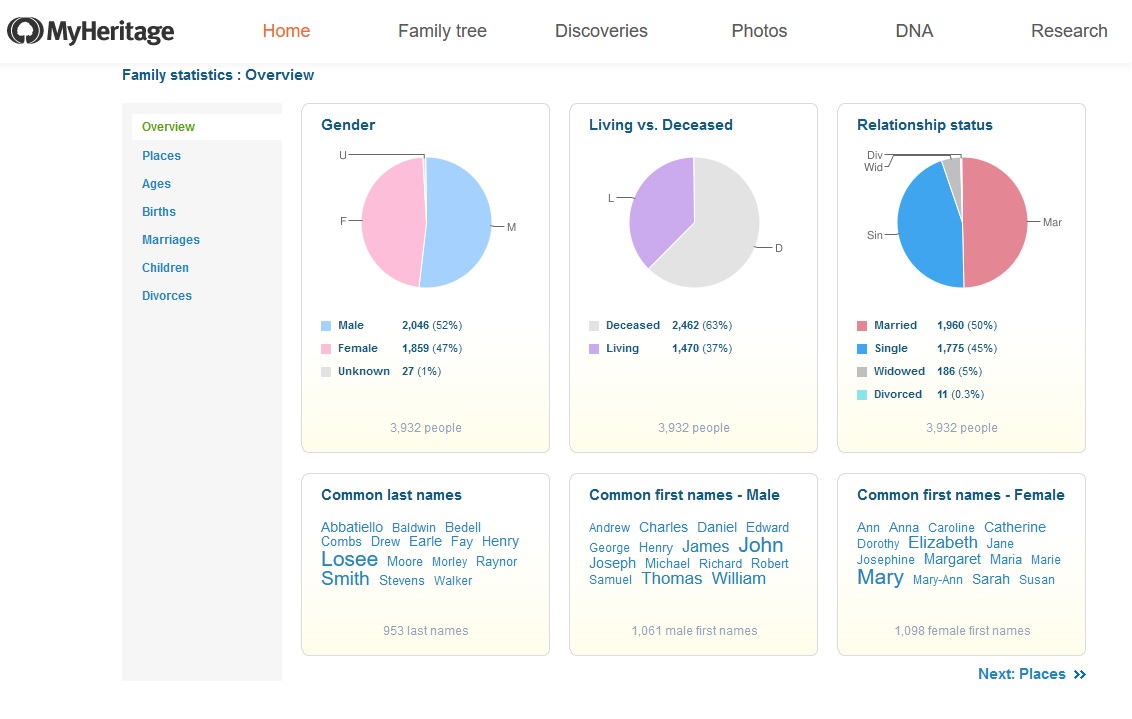
4. FAMILY STATISTICS: This is a neat feature that presents aggregate data from your tree. Just fun factoids like I haven't set the gender for 27 individuals in my tree, thus 52% of my family tree is male, 47% is female, and 1% is of an unknown gender. The most common first name for males in my family tree is John and for females is Mary. 

And ta-dah, 5. TIMELINE: The Family Tree Timeline can help you visualize your ancestors’ lifespans, including whose lives overlapped and what major world events they lived through. It is a visual representation of the direct ancestors of one individual from your family tree, you are typically the default person. The lifespans of these individuals are presented on a bar graph. By default the Timeline shows 4 generations, from you to your great-grandparents. However, you can choose to display more or fewer  generations.

Each person’s name, profile photo, and age appear on a colored bar. If the individual is deceased, their bar is rounded on the right and their age at the time of their death appears at the far right. The bars representing living individuals are squared on the right and their current age appears there. If the date of birth or death is unknown, the bar will be faded towards the birth or death date, ending at an approximation of the time of their birth or death.

However, what I wish Timeline did was show the overlap of lifespans for family groups, not just direct ancestors. I'd like to see my siblings, cousins, aunts/uncles, etc. represented on a timeline. I think it would help my research in a lot of way. For example, such a feature might help pinpoint a date on which a group photo was taken. For example, I have a group photo with 10 people in it. I can identify 9 of them. I know it has to be taken before person A died and after these six kids were born. Maybe I could figure out that 10th person if I could see who was alive at the same time.

ABOUT THE 1950 CENSUS: MyHeritage came up with this awesome tool shortly after the recent release of the 1950 U.S. Federal Census that kind of incorporates their Timeline capabilities. Under "Research" there is a new link for Census Helper. It generates a list of individuals in your family tree who are likely to be found in the 1950 census. In fact, it does this for any U.S. census you're researching in as well as censuses for Canada, Ireland, Scotland, Denmark, Norway, France, and England & Wales!

Again, MyHeritage has great features which if you have never explored before, you should!

Monday, April 18, 2022

52 Ancestors Challenge Week 16: "Negatives" - Off Topic - How to spot an NPE

The objective of this 52 Ancestor Challenge is just to get one writing about their family history research. Nothing says I have to stick to the suggested topic. This week's theme is "Negatives" and there is just nothing from my own family history research that springs to mind. When I hear "Negatives" I think of film negatives, which shows my age I guess but I don't have any negatives in my collection. Then I think of blood types. And the only members of my family for whom I know their blood type is me and my dad. I'm O+ and dad is A+ so no negatives there.

Instead I'd like to write about the ways I have been helping other researchers lately. That is through analyzing DNA test results.

First, for those of you who do not know what an NPE is, it stands for a Non-Paternity Event or Not Parent Expected experience. No matter what the letters stand for, NPE is common parlance for finding out you are adopted or your father is not your biological father. Now this could be something you discovered about yourself, it could be something you know going into your DNA testing, or it could be some mysterious DNA match you have that is facing this predicament.

And trust me, this happens more than you think. It has happened all throughout history. Hanky-panky has existed as long as mankind. Let's not paint it all with the same brush, though. Sure, spouses cheat, teenagers have unprotected sex, but women also get assaulted, or chose to be single mothers and opt for artificial insemination, and people give up children for adoption for all sorts of reasons. Back in the day it was all much more secretive than it is now. Hell, now it is very common for the birth mother to select the adoptive family herself. Some parents communicate with the birth mother (and perhaps the bio father as well) through letters and pictures throughout the child's life. 

Again, my post is not meant to be negative at all. I am just bestowing my advice to you if you are thinking about taking a DNA test. If you can't handle the truth, don't take a DNA test. Everyone ought to be prepared to be shocked when you look closely at your gene pool. That's all I'm saying.

Here are the first few things you should do when analyzing your AncestryDNA results:

1. Don't take a DNA test until you have built yourself a substantial well-documented family tree. There are a few reasons I recommend this but the most obvious being you need to know some of the surnames that are going to pop up among your DNA matches. Try to know your great grandmothers' maiden names going into this and who her sisters might have married. Because in my experience very few of my DNA matches share my surname. And it helps to know if you have very large families in your family history. Was grandma one of 5 or 15? The bigger the family the more likely the more matches you'll have on that line.

2. Connect your DNA to your family tree. This will also help to trigger any alarm bells that might need to be heard. AncestryDNA has a feature called ThruLines. This feature is no more reliable than using someone else's tree as a source. And, as you probably know, there are a lot of bad family trees out there. By "bad" I mean wrong. Just wrong. Someone has my grandfather's WWII Draft Registration attached to their great uncle. Dude is just wrong. 

Typically you can suspect a bad tree when no sources are attached to any people in the tree. That's a sure giveaway that the person has not done the research. Don't copy anyone's tree. Look at the sources they use before adding anyone to your tree. So don't "trust" ThruLines. It is, after all, based on the family trees of your DNA matches. However, if you link your DNA to your tree and then look at ThruLines and see you have absolutely no DNA matches who have the same people in their family trees, well, then you, my friend, may be looking at an NPE.

3. Look at the pie chart (a.k.a. ethnicity estimates): I wish people would stop caring about this feature so much. You know these estimate are just that - estimates. And surprise, surprise, they are going to change over time. Oh yeah. Every time the company updates it's algorithms you get more Irish or Jewish or maybe like me, your Central European disappears. Nice, huh? Stop caring about this so much. I only mention it in case the estimates are overwhelmingly not what you expected. Maybe you are like me, kind of a WASPy American mutt. I've got a little bit of everything going on in my tree. I expected Irish, English, French, German, Czech. But I don't have any known Italian ancestors for example. If my pie chart had come back 50% Italian, that should set off alarm bells. I had a client who took her DNA test expecting to be 100% Italian. She came back 50% Jewish. What does that tell you? Maybe her father isn't her biological father? BINGO!

If no alarm bells have gone off for you yet, try this...

4. Apply the Leeds Method: The Leeds Method is a technique developed by genealogist Dana Leeds in which you examine your shared matches with those in your second cousin range (400 cMs - 90 cMs) which will result in about 4 DNA groups; each group will align with one of your 4 grandparents. Now this doesn't always work out for people for a variety of reasons but for most people it is a wonderful tool. Let's assume you get 4 groups.

Now, cMs or centimorgans are how DNA is measured. The amount of DNA you have in common with someone forecasts the relationship you might have with that person. For example, 1600 cMs is likely a half-sibling or an aunt/uncle. A half sibling or an aunt/uncle will have 2 grandparents in common with you. So the Leeds Method will color code these people into 2 groups and they will align with either your paternal grandparents or you maternal grandparents. Now you will likely know these people. If you don't, you ought to. Do you hear that ringing noise? You should be able to identify your aunts, uncles, and half-siblings without research. They should have shown up at some family function at some point in time.

Additionally, this method will help you group together distant cousins who only connect to one of your grandparents. So where as cMs help one to determine the potential relationship, the Leeds groups helps you to place those relationships on the correct branch of your tree.

Again, it doesn't work for everyone but it is one of the first techniques I use to help sort out someone's matches.

Now, I have a DNA match at 183 cMs which puts him in a range likely to be a half 2nd cousin, or a 2nd cousin once removed (my mom's 2nd cousin), or a half 1st cousin twice removed (my grandma Gardner's 1/2 cousin - meaning they share 1 grandparent), or a 1st cousin 3-times removed (one of my great grandparents' 1st cousins on my grandma Gardner's line). It is hard to say for sure because the man has no tree up, no profile describing his age or where he lives, and he has not replied to any of my Ancestry messages. Ordinarily I'd go looking for him on social media but he has a really common name, Daniel Clark. Don't be afraid to reach out to a match. These people took a DNA test. Some part of them wanted to find connections to other people. Connect!

I'd love to know how I'm related to Danny, so if you know him, please send him my way. I suspect he might not know who his bio father is. I don't either but I can certainly help him narrow it down.

That's my advice for if you spot an NPE in your life by any of the above described steps - COMMUNICATE! People are so afraid these days to call someone up or contact someone they match. There are so many scammers out there, sure, people are going to be suspicious but you're never going to know more if you don't ask. "Well, I don't want to upset anyone" And what if the information you share is what they have been looking for their whole life? What if what you have to share brings them joy or closure? Just reach out and ask.

Not everything has to be so negative. (See what I did there?)

Sunday, April 3, 2022

Genealogical Excitement Afoot

The last few days have genealogically very significant. Aside from the release of the 1950 U.S. Federal Census and New York City Municipal Archives making their vital records freely accessible online, several of my recent DNA clients had milestones.

Yeah, in my free time (Haha - like I have any free time), I have been picking up DNA projects hear and there for the last few years. I've been really quite successful with my work on unpuzzling DNA matches to find biological parents. There is something very gratifying about helping others to learn the truth.

  • On Wednesday, March 30, a man I was helping to figure out who was his maternal grandfather was, received confirmation in the form of a DNA match to a half-aunt.
 
  • Yesterday, April 2, the client I had to tell he was adopted, spoke with his bio mother for the first time in a video call.
 
  • Today, April 3, I attended a local event with the woman for whom I found her bio father for last year. There I met her husband, daughter, maternal grandparents, as well as her bio father, his wife, their son, and her bio paternal grandmother.

Another incredible thing that I learned about yesterday came in the form of an email from a former graduate student. In my course my students are required to create a well-researched tree on Ancestry.com. They don't have to make it public but we use it to communicate about their research. 

This student had her tree public and last week her family received a knock on the door from the FBI. Yup, apparently they had a 2017 cold case. The unidentified remains lead back to a family my student had in her tree. Her mother hadn't tested, so it wasn't that they found them through a DNA match. No. The DNA matches they did have must not have been close enough or did not supply substantial family trees. Thus the found my student's tree and are now testing to confirm if this deceased individual is connected to her family line.

Kind of fabulous right?

DNA testing opens a whole can of worms, maybe not for you. maybe you're biological parents are legitimately the people you were raised by but I bet you anything someone in your list of DNA matches is searching for their biological family either because of adoption or misattributed paternity. 

And if your DNA or family tree can bring peace to a distant family member in the form of notification that their loved one is no longer a John Doe, why wouldn't you want to be part of that?

Exciting stuff, my friends, exciting stuff.

If feels good to give people the truth.

Tuesday, March 22, 2022

52 Ancestors Challenge Week 12: "Joined Together" - Meeting Cousins

I suppose this week's theme of "Joined Together" is supposed to cause me to reflect on marriages in my family history but the cynic in me only makes me think of the many divorces I see in my family history. In effort to be uplifting in my posts, I'd rather write about something that makes me happy; meeting cousins.

I have many known cousins to begin. I am one of 9 first cousins on my mother's side and one of 10 first cousins on my dad's side; subtracting siblings from the mix, I have 12 first cousins in all. However, I have acquired so many distant cousins since doing online genealogy research and especially since doing an AncestryDNA test back in November of 2013. Some of them I communicate with for only a brief time, exchanging information to enhance our respective family trees. Others I have communicated with sporadically for years and years.

There are so many that I can't possibly list them all. I'll highlight a couple of them though. These are ones I have acquired strictly through genealogy research...

The One Who Has Been Around the Longest: Cousin Mary

Cousin Mary is my father's 6th cousins and thus my 6th cousin once removed. We have my 6th great grandparents in common; the elusive Jacob Raynor (unknown - March 1829) & Rebecca Raynor-Raynor (June 10, 1769 - February 14, 1855). That's right. You read that correctly, Rebecca Raynor-Raynor.

We have deep Long Island roots that reach back to the settlement of Freeport, New York which at one time was known as Raynortown. One might think Raynor is not a common surname but at that time, in that place, there were SO many Raynors. I am sure Jacob and Rebecca were cousins of some ilk but both Mary and I struggle to confirm Jacob's parents.

I honestly can't remember how long ago Cousin Mary and I met, maybe since 2005-ish, but we have "joined together" on many occasions. We have done a few research trips, attended a conference, and did a genealogy presentation together. We met back when Ancestry showed you other users who had connected to the same records.

I recall being quite dismayed when we did not match on AncestryDNA though. I thought for sure I had made some research error and that Mary was not my cousin after all. Oh, I was so sad but I was quite relieved when it turned out that, although my father and I do not match Mary, my 2 uncles do. It proved that it is possible to have no genetic match with distant cousins.

It is about 2 years ago now that another researching cousin on our line passed away. Recently, Cousin Mary and I accepted the generous honor of inheriting that cousin's boxes of resources. We also recently planned to attend another conference together in June. Can't wait!

Thus, Cousin Mary and I have "joined together" in many research endeavors. She is one of  my best genealogical finds.

The Non-Genealogist Genealogy Acquired Cousin: Cousin Chris

Cousin Chris is not a genealogist. He and I are 3rd cousins on my mother side. This is the side of the family that I really don't have many strong bonds with so it is nice to have cousins on that side turn up. 

Cousin Chris and I have our great-great grandparents in common; Damas Desjardin, also known as Thomas Gardner (October 9, 1850 - October 2, 1911) and Malvina Ethier-Desjardins (February 2, 1864 - January 6, 1944). I met Chris by way of his brother, Cousin Robert, who is the genealogist. However, I have never met Cousin Robert. He posted a question to a message board a long time ago, around 2009, and then put me in touch with his siblings via FaceBook.

At the time Chris kindly extended an invitation stating, "If you're ever in Minnesota..." Well guess what, my constant road companion Cousin Pete and I were off to Minnesota in the summer of 2015. Cousin Chris (who is no relation to Cousin Pete, by the way) put us up in his home for 4 days, no questions asked. His beautiful wife and fabulous kids were so welcoming. The little cousins, gave up their beds for us. By the end of our stay Cousin Chris inquired, "Um, how are we related?" Needless to say Pete and I have been back to visit Cousin Chris and his family several times. In fact, this past summer we met up with them in Philly and stayed in the worst AirBnB I've ever stayed in in my life. Cousins made it tolerable.

The Not Quite Sure How We Are Related Cousin: Cousin Tim

A little over a year ago I received an Ancestry Message from Cousin Tim stating that he had been looking at his cousin's DNA matches and discovered I managed a few of the test with whom he matched, my father's and one of my uncles. They are distant DNA matches and originally we thought perhaps it was a connection to the Hinch family of Hacketstown, Ireland but then again, it could be through the Hughes family of Liscolman, Ireland. Either way both are in Wicklow Co. and on Grandma Earle's line. We're related somehow. I hope some day we can figure it out. Either way though, we're still cousins.

The Cousin Who Made Me Jealous by Getting to Visit Our Ancestral Homeland: Cousin Carol

Those of you who know me in real-life, you likely know that I am a ferocious road-tripper. I have been to all 50 states and all the provinces of Canada with the exception of Nunavut. Aside from Canada though, I haven't done much travel outside of the U.S. Cousin Carol has been to the most "exotic" of all my ancestral homelands though, the Czech Republic. My ethnicity pie chart reflects 99% European, most of which is from the British Isles and Ireland, thus Central European seems exotic to me.

Cousin Carol and I are 3rd cousins once removed, meaning she and my mother have my 3rd great grandparents in common; Jan Prinz (May 14, 1826 - May 22, 1888) and Franzisca Preuss-Prinz (November 17, 1830 - November 29, 1902) who were from Mladá Vožice, in Southern Bohemia, which is now the Czech Republic.

After years of researching our shared ancestral line, in the summer of 2013 she had the opportunity to visit the Czech Republic with her husband to celebrate their 40th wedding anniversary. They hired personal, professional tour guides who arranged ancestral tour and provided genealogical research which included meetings with village and church historians. Not only did they get to travel the roads our ancestors would have traveled, they got to visit the church where my great-great grandfather was baptized and had the privilege to ring the church bell which had been cast in 1491.

Even though we did not "join together" for that trip [JEALOUS], I did live vicariously through her and asked her to guest blog about her travels for me.

The Fancy Meeting You Here Cousin: Cousin Sylvain

In June of 2018, I had a second opportunity to visit Twillingate, Newfoundland, my Earle family's ancestral homeland. I had a truly astonishing genealogical discover then. I have written about the experience before but it still overwhelms me when I think about it. 

In brief, Twillingate is where my great grandfather, Abram Thomas Earle, was born in January 1891 on Farmers Arm which is on the Durrell side of Twillingate. On my second visit I went with my Uncle Tom. We stayed in a magnificent AirBnB called The Pumpkin House located right on Farmers Arm Road. One of the homeowners, Charlie, had recently purchased another house just a few doors down from Pumpkin House on the same road. 

One day he invited us down to his new house to show us his deed. It clearly shows a survey conducted by Thomas Peyton who was once the local magistrate and was the father of Edgar Peyton; the brother-in-law of my great grandfather and thus my uncle's great uncle. 

It turns out that Charlie's property was once owned by John Earle. Yup an Earle! The deed also indicated the land was once owned by the Late William Earle who, one would assume is the father of John, the aforementioned land owner. William Earle was my great grandfather's uncle. My gut tells me that my great grandfather was born on Charlie's land.

But it gets crazier. While Uncle Tom and Charlie poked around in one of the old structures on the property, I chatted with Charlie's friend, Sylvain. Our conversation went a little like this.

April: "So do you live here year round?"

Sylvain: "No, I live in Montreal."

April: "Oh, that's where my mom's side is from. My father's side is from here in Twillingate but my mom's side has deep roots in Montreal."

Sylvain: "I have ancestors who were early settlers in Montreal. What's the family name?"

April: "It would have been Desjardins." 

And Sylvain froze. This very blank expression came across his face and he slowly said, "My mother's maiden name is Desjardins."

Turns out Sylvain is Cousin Sylvain. He and I have my 9th great grandfather in common; Claude Jourdain Desjardins Charbonnier (1636 - about 1704-1711).

Crazy stuff; to not only find my father's family homeland but to meet a maternal cousin on that land - kind of crazy! By the way, my mother and father grew up next door to each other.

Since meeting, Cousin Sylvian has helped me with finding some information about our Montreal roots. Lovely man.

The Most Recently Acquired: Cousin Kristen

Just before Christmas 2021, I got in touch with a new DNA match, Cousin Kristen. She too is a cousin on my mother's side. Again, I have so few strong connection of that side that I am always excited by the potential for new relationships there.

Just recently we met in-person for the first time. We talked as though we were old friends catching up. I hope that such visits will become common place for us.

At this first visit, Cousin Kristen gave me a ring her and her mother chose for me a limited number of family heirlooms. She joked about proposing to me with it. I haven't taken it off.

Monday, January 31, 2022

52 Ancestors Challenge Week 5: "Branching Out" - Great-great grandparents Michael & Agnes Fay

For the last few years I have been working a lot with genetic genealogy. Mainly helping people find their biological parent or parents. In the summer of 2020 I decided I would dive more deeply into my own AncestryDNA results. My goal was to place 100 of my matches into my family tree. In order to do that, I most certainly had to expand my family tree; branch out as it were. I'll explain a little bit about how I did that.

Last week, though, I received an Ancestry message from a DNA match suggesting we might be 2nd or 3rd cousins based on what AncestryDNA suggested. Well, I already had built Cousin Lori in my tree and was able to quickly say, "Oh, we're 2nd cousins once removed on my mother's side." I Love it!

Ideally, Step 1: Make a fleshy tree! 

I really think it is best to do your DNA testing after you have developed a really fleshed out family tree. Get back at least to a few great-great grandparents and expand the tree by including everything you can find on your direct ancestors' siblings and their offspring. Make a fleshy tree!

I do realize though that it is not always the order in which genetic genealogy research comes into play. For example, I had a friend who had a good fleshy tree. He took an AncestryDNA test and linked it to his tree. And oddly, none of his matches popped up in ThruLines. 

ThruLines is a feature of AncestryDNA that shows you how you may be related to your DNA matches. It is based on information from your DNA matches' family trees. Now if you have been doing genealogy research for sometime you know how shitty some family trees can be. Lots of "researchers" just copy information from other people's trees without vetting the information themselves and backing it up with documentation. In short, you can't trust ThruLines. It might not place your DNA matches in the right place - - BUT once you link your DNA to your tree, ThruLines should recognize some of your direct ancestors in the trees (even shitty trees) of some of your DNA matches. For my friend it did not.

I had to break it to him that he was adopted. 48 years-old and the thought never crossed his mind. That is when genetic genealogy comes to play a bigger role. For most of us though, we aren't adopted and our fathers are our biological fathers. Thus, once you link your AncestryDNA results to your fleshy tree, ThruLines will show how some of your matches may be connected to you. If it doesn't, hate to break it to you but you're probably adopted or you have some bad research going on in your tree.

I generally, I did not use ThruLines to get my 100 matches in my tree though.

Step 2: Look at your match list.

That ethnicity pie chart is junk science if you ask me. It's interesting, sure, but it's not going to tell you who your great-great-great grandparents were or where they lived. I wish people would stop caring about estimates so much. Sure busted fender, need a kitchen remodeled, want to know how long the wait will be for dinner, go get all the estimates you want. Genealogy isn't an estimate.

And ThruLines I already discussed. 

You want to figure out who you have in common with each of your matches!

I am fortunate to have a lot of known family members who have tested through AncestryDNA. Let me count... 43! 43 of my DNA matches on Ancestry are people that I have either spoken to face-to-face in-person during my lifetime or conducted online genealogy research with and expected to see in my DNA results. That's a lot. Then again though, it is a big family.

When you open your match list, Ancestry now asks you if you know the person. You want to fill that out if you can.

Step 3: Link the known family members into your tree!

You should know almost everyone in the following groups: Parent/Child, Full Siblings, and Close Family. 

Towards the bottom of the Close Family group there might be a few people you don't know; typically some cousins of your parents or some second cousins wind up there. Second cousins are people with whom you have the same great grandparents in common. A majority of your Parent/Child, Full Siblings, and Close Family should already be in your fleshy tree. If not, maybe your tree isn't really that fleshy. Go flesh it up! Or maybe we need to have that heart-to-heart.

When you click on the name of a match in the list, it opens their DNA profile.

Next to their name you'll see a symbol which to me looks like the face of the Man in the Moon; a circle with a little pedigree shaped Y and a plus sign. Like this: 

Right? Looks like the Man in the Moon's face, doesn't it? Well, that is what I see. Anyway...

Once you click on that, a panel will open to the right and you can search for the person in your tree. If they are in your tree, it will link the match to the tree. 

Done!

Wait! What about the other 57 people that I worked into my tree that I didn't know in real life??

Well - - - 

This is when the work starts!

Step 4: Look at their linked and unlinked trees.

Sometimes Ancestry will show you that you and your match have a common ancestor in your respective trees. That will look like this:

Examine their trees. Build their line down into your tree from the ancestor you have in common down to the person you match to. Making sure you review their connected documents, etc. Build them right in. THEN you can use that "Man in the Moon"-tool and connect that match to your tree.

That technique added about another 30 linked DNA matches.

The remaining 27 to 30, you ask. Well about a dozen or so had unlinked trees that or "unavailable" trees. It took a few more clicks then to open their trees and look around for our possible common ancestors.

The additional dozen required much more work to link them to my tree. I had to apply the Leeds Method, look at what shared matches we had, email some of them, snoop for them on social media, etc. I used a bunch of techniques but you can do this. YES you can!

AGAIN, Branch out! 

Explore the siblings of your direct ancestors through documentation. Add them into your tree.

So, when my 2nd cousins once removed on my mother's side reached out to me because we had a DNA match - - remember her, back in paragraph 2 - - Cousin Lori - - she was already in my tree because I "branched out." 

Based on her Ancestry tree, which was not linked to her DNA, I could see exactly who we had in common; Michael Fay (October 1852-  13 January 1915) & Agnes Joyce-Fay (12 August 1865 - 12 December 1933), my great-great grandparents.

The Family of Michael & Agnes Fay

Michael Fay, my great great grandfather, was born in Saugerties, New York in October 1852 to Lawrence Fay and Bridget Kelly (or Kelley)-Fay who were both born in Ireland. Based on census records and records from St. Mary of the Snows Roman Catholic Church in Saugerties, New York, I believe that Lawrence and Bridget had 7 other children after Michael from about 1854 to 1869: Thomas, James, John, Martha, Joseph, Anne, and Lawrence J.

Agnes Joyce-Fay, Michael's wife and my great great grandmother, was the daughter of John Aloysius Joyce (11 February 1829 - 30 September 1910) and Mary Ann O’Neil-Joyce (about 1829 - 11 January 1911), again, both of whom were born in Ireland. Agnes was the youngest of their five Joyce children. Her four older siblings were named James, John, Mary, and Gertrude; all born between 1854 and 1863. 

Michael and Agnes Joyce-Fay had six children of their own: Leo (28 January 1888 – 27 January 1819), Anna (3 February 1889 – 5 February 1819), James (my great grandfather - 11 February 1893 - 1 October 1964), Mary Ann (17 June 1897 – 1965), George (7 October 1898 – 6 April 1976), and Agnes (April 1900 – unknown). 

This is what I mean by "branching out" and making a "fleshy tree". I had all these siblings in my tree when Cousin Lori contacted me. I descend from Michael and Agnes's son, James. Cousin Lori descends from their son George. I had already had documents attached to George including his marriage record and census records identifying his children. Years before I had already communicated with other cousins from this line. So although I don't "know" Cousin Lori, she was already in my tree thanks to that DNA match and good old fashion genealogy research through documentation.

Thursday, December 16, 2021

Year In Review

With the end drawing near, it is a time to reflect on what has been accomplished in the last year, genealogically speaking.

If you follow my blog you know that this year I set a goal to locate and visit the burial locations of all my direct ancestors back to, and including, my 3rd great grandparents. When I started my mission I had determined that included 23 individuals, 10 of which I had little hope of finding. Well, I have 9 that I did not get to, most of which are buried in Canada. Although I tried to find burial locations for them, I couldn't find them and even if I had, traveling to Canada during this global health crisis wasn't a good idea. At points, international travel wasn't even permitted.

In addition to visiting 14 graves, reaching 60% of my goal, I also replaced a headstone. It is the stone for my third great grandfather, Victor Henry, and two of his sons, Joseph and Louis. I did so with the help of many many relatives. 

I gave a presentation about that project through the Allen County Public Library (Indiana). In fact I spoke several times this year about genealogy research. I gave 7 formal presentations to be exact.

I also spent a great deal of time unraveling DNA cases of adoption and unknown parentage. All with great success really.

I guess it is now time to start thinking about a goal for '22. I am open to suggestions. 

I hope you all have a wonderful holiday season and wonderful 2022.

Wednesday, March 31, 2021

It's a Dad!

Tuesday night, March 29, 2021, confirmation came in for my most recent client who was searching for her biological father (It Is Him! - written 3 Feb 2021). The confirmation was in the form of his DNA results. They match on AncestryDNA as parent/child.

It was a long arduous process but it feels good to solve such a meaningful mystery. 

I couldn't have figure it out, though, had it not been for all the biological cousins out there who also took DNA tests.

You may not know who you are helping when you take a direct to consumer DNA tests. There are many people opposed to this kind of information being out there. They have legitimate concerns about their privacy and the future of privacy in general. But great blessings can also come out of genetic genealogy.

I hope my client and her biological father can develop a mutually beneficial, positive, adult child/parent relationship.

If you are struggling to learn about your biological family:

  1. Before you even take a DNA test, learn how to interpret your results and about the limitations DNA testing can run into.
  2. Accept that you may never know the answer you seek and that what you find may not be good.
  3. Get a good strong support system around you because it is a freakin' emotional roller coaster.
  4. Then test everywhere you can. You never know where that significant cousin match will be.

Wednesday, February 3, 2021

It Is Him!

For the past 5 years or so I have taken to unpuzzling DNA matches for people. Every year I take on someone new. I don't charge them and I don't promise them results.

It started with a woman who knew she was adopted and wanted to find her birth parents. It was a struggle and I honestly did not know what I was doing. I didn't get very far. I did the best that I could at the time. To this day I don't know what became of her research.

Then there was an email from a man who matched to someone for whom I manage a DNA kit. He was startled to learn his father was not his biological father. We sorted that one out, found out who his bio dad was, but unfortunately, that man was deceased. There was no "reunion"; happy or otherwise.

Then there was a client I had worked with on researching her family tree who knew her father was not her biological father but did not know who her bio dad was. After a DNA test and a very close match, I was able to determine who her bio father was and put her in touch with cousins. Again, that bio dad was long deceased as were the client's half siblings. Again, I don't really know where it went from there. It sort of fell flat for me. I don't know what relationships she pursued, if any, or what developed.

Then I worked with a woman whose grandfather's mother was adopted and who did not know his biological father. That was a mess. And ultimately, I did not have enough information to work with. The grandfather who had been tested did not have enough known or close matches for me to get very far. I did figure out one certain connection to a family but the woman kind of didn't want to hear or accept what I was trying to explain. I got frustrated. I gave her the information and ended communication. I don't know where her research went from there but when you're working for free, you don't owe them anything.

Just recently though I've had a great success. Yup! I have helped a woman to find her biological father who is alive and well and speaking to her which is not the case with her mother. Her mother is alive but this pursuit to find her bio dad has cracked an already strained relationship she had with her mother to the point where they no longer speak. When one is in pursuit of the truth it's very hard to see eye to eye with someone so deeply in denial.

What most people want to know though, is how do you figure this out. For the genealogist we spend a lot of time while working on such projects thinking about how this came to be. I mean **blushes** We know how it happened, but we think about where people were geographically during a specific period in time, how the couple could have met, and we rule out potential parents based on age, date of birth, locations, and the like.

We tend to invest so much time in the genetic puzzle that we think that is the hardest part. The truth of the matter is the aftermath is the hardest part. Once you figure out who the parents are, what happens? That's the part that the genealogist is not always privileged to. And sometimes the results are anticlimactic. 

So this most recent success I pray remains just that - successful. I hope my client builds a health relationship with her bio dad. I pray he is sane and stable and able to handle this news with the grace and maturity we have seen so far. As for her relationship with her mother, I am not sure there is repair there. I have no advice for her. Except to say that I myself am estranged from my mother. It can be hard to have a healthy relationship with a parent when you too are an adult. You're always their child but you're not a kid. And again, when one is in pursuit of the truth it's very hard to see eye to eye with someone so deeply in denial. Maybe if mom comes to terms with the truth you can be adults together; IF she comes to terms with it. 

Again, I pray this remains a success.

Wednesday, December 23, 2020

NPE: Get your head around it & use the Leeds Method

My last 6 month during this worldwide health crisis and year of turbulent politics in the U.S. has been spent absorbing, reflecting, and distracting myself to find what really matters most to me. Working from home has been exhausting and, at the same time, just fine. It's made me mushy though - mentally and physically and thus I struggle to stay sharp. 

One of the skills I have worked to sharpen this year has been in interpreting DNA results. Not only can I evidence this work by pointing to the 100+ DNA cousins I have linked to my Ancestry tree, I have also helped several people in their search to find their DNA relatives. In one instance in particular I assisted a woman in locating her biological father. If she reaches out to him is yet to be decided but with 99% confidence, we know who he is because I could find DNA matches between my client and 3 of his 4 grandparents.

Like most family stories, hers is one that is complex and emotional. She, like so many now, experienced what is often referred to as an NPE; Non-Parentage or Non-Paternity Experience. In short this is when someone takes a DNA test and discovers their parent or parents are not their biological parent(s). In my client's case she always suspected her father was not her biological father but a DNA composition of 50% of an unexpected ethnicity confirmed it. 

Those pie charts and ethnicity estimates are not really very meaningful to me. I don't feel ethnically anything. I don't hyphenate myself. I'm not Irish-American, German-American. You never hear Canadian-American really. I think of myself as a long-term American, from a really well stirred melting pot, if you will. I don't care very much if I am 23% French or 37%. I'm not swapping my kilt for lederhosen because frankly, I wear jeans. But when you see an ethnicity which you don't expect in such a large percentage in your ethnicity estimate, it's a tell-tale sign that something is amiss. "How can I be 50% Italian when I don't have a single Italian surname in my family tree?" Um, well you can be if you really don't know half of your genetic tree.

Sorting out your matches is how you determine your biological parent(s). And, I have found, that you need close matches. By that I mean people with more than 100 centimorgans of DNA in common with you, and several of them. They also need to have a comprehensive family tree that you can view and/or you need to communicate with them.

Typically people think they can click a button and get their answer. It doesn't work like that. It is a long, slow, arduous process but the desired results are totally possible. 

The first step in any of it, though is that if you or someone you know experiences an NPE is to first relax. Get your head around it before you start your search. The older you get the easier it is, I think, to see your parents as people; people who did some things, made some choices, didn't know what they were doing, etc. Once you have a grasp on that - which can take a really long time....

Then, sort those matches. The Leeds method has been the most useful took I have employed. Use it!: https://www.danaleeds.com/dna-color-clustering-the-leeds-method-for-easily-visualizing-matches/

Tuesday, June 9, 2020

100+ AncestryDNA Matches in My Tree

So I did it! Two weeks ago I set a goal for myself; to get 100 of my AncestryDNA matches linked into my family tree. I did it! 

I have a lot of DNA matches. At present I have 693 people who matches me as 4th cousins or closer and that number is ever increasing as more and more people invest in these genetic testing kits. Of course those 693 people are matches to people who have taken a DNA test through Ancestry - no other company and, no, the system is not just guessing based on some fancy algorithm if I could be related to those people. I am related to those people. Our DNA matches.  I have an ancestor in common with each and every one of them. Which ancestor? Well, that's the puzzle. 

In some instances I knew right away who the common ancestor was given the fact that my father, my sister, several of my first cousins, many of my known first cousins once removed, and their kids (my second cousins) have all taken DNA test through AncestryDNA. 

A good 50% of the 100 matches I could reach out to right now via phone, text. email, or FaceBook Messenger. No problem! 

I recognize that for other connecting 50 DNA matches to their family tree could be a big challenge but I come from a very big family. Some branches are incredibly close. Most of my very best friends are my own second cousins. Many people do not even know their second cousins or even really know what that term means. (Your second cousins are those people with whom you share great grandparents. In other words your parent's first cousins' kids.)

Another factor that contributed to being able to link so many matches into my family tree is the fact that I have been at this family history research thing for over 30 years now. I've gone to several family reunions in my time and have been able to collect names and birth dates of many, many living family members. Looking over some old paper written list of reunions put about another 20% of my found matches into my tree. These were living people who took DNA tests and that I knew of. That is to say I probably met one of their parents at a family reunion. Their names were not in my family tree on Ancestry until I gave myself this challenge of linking living AncestryDNA matches into my tree. I might have had their parent or grandparent in my tree but not them. They are in there now.

For the other 30% of my now linked matches, they were the real puzzles. The success of linking them to my tree took a combination of reaching out to them or those that manage their DNA kits through my Ancestry membership's email feature. Typically you don't hear back through Ancestry's email. People typically use Ancestry for a brief time and then check-out. Maybe they used the free 2 week trial of Ancestry or they just took a DNA test to see their ethnicity profile. they are not active users. But I got lucky with a few contacts. I had a wonderful exchange with my paternal grandmother's second cousin. I was able to fit her and her sons into my tree. She shared with me recollections of my grandmother and her siblings. Uncle Bobby Henry was a talented musician and my grandma and grandpa Earle attended this cousin's wedding.

In other cases I could put those other 30% in my tree by looking at their trees. This requires that both of us had to have pretty fleshy trees. To match a 4th cousin you have a 3rd great grandparent in common. Now fortunately I have been able to connect my research to all 32 of my 3rd great grandparents. They were all born between 1782 and 1855. 

Having researched all of my 3rd great grandparents I was able to recognize common surnames right away. For example, when I saw the surname Goodyear in one person's username I knew right away that cousin was probably connected to my 3rd great grandmother; Sophia Goodyear-Earle (1808-1877). 

Opening that cousin's public tree concealed his living father's name but showed his Goodyear line back to Sophia's brother. I had never research Sophia's brother. I didn't have any of her siblings listed in my tree - - but now I do. I combed through enough records to confirm this Goodyear cousin and I have my 4th great grandparents in common; James Goodyear (1787 - unknown) & Susanna French-Goodyear (1797 - 1829) of Twillingate, Newfoundland by way of Harbour Grace, Newfoundland.

Did I learn anything new?

Well, no. Not really. I added over 1,000 names to my tree working on this project during the last 2 weeks but I didn't really learn anything new or alarming in some way. 

I met a few nice relatives.

There are a few people that I have pretty significant matches with that I can't fit in my tree. In many cases that is because they don't have a family tree on Ancestry. Again, maybe they just checked-in for their ethnicity profile but in some cases I do suspect an adoptions or misattributed fathers are in their trees.

So what did I get out of this other than a much bigger tree and a few nice conversations?

Well, I feel very well prepared now to help others sort out their DNA matches; others who might be adoptees or those who have discover that they do not genetically match their father. If you need help sorting your DNA matches don't hesitate to reach out to me.